Tuesday, January 11, 2011

Sceptics ask: Is the UK government’s climate propaganda machine finally falling apart?


Just when you think things are as inanely silly as they can be, they raise the stakes. It’s a game of double or nothing in the race to the bottom. The close common interests of three big government agencies is fragmenting and instead of skeptics launching the FOI’s, this time, the BBC is.

Just in case there is anyone who doesn’t know, the UK Met predicted a winter a couple of degrees above the usual. Then supertankers of snow turned up and dumped on the nation, surprising people, and making life difficult for everyone who hadn’t made arrangements for the return of the British Blizzard and the coldest December on record. The UK Met, having got it completely wrong, decided the best course of action was to announce post hoc that actually they did get it right, really, they predicted cold weather, but they didn’t tell the public, they just told the politicians. The politicians apparently asked them not to let on to the public, or so the story goes, and the plot thickens.

One way or another someone is using tactics with all the forward thinking you’d expect from a five year old. If the Met office is not incompetent then the implication is one of implacable dishonesty from either the BOM or the UK government (or possibly — both).

The BBC reported it, without asking too many hard questions, which makes them look a bit silly too. Now, instead of the Big Scare Campaign Team working together, three big formerly aligned groups are fighting for their own cred. The BBC versus the Met, versus The Government.

On January 6th the GWPF asked:

Did UK Government Keep Cold Winter Warning Secret In Run-Up To UN Climate Conference?

It would appear that the extreme weather warning was kept secret from the public.

According to media reports, the Cabinet Office has been unwilling to confirm whether or not it failed to pass on the Met Office warning to local and road authorities, airports and water companies.

“Not only is the lack of Government preparedness a cause for concern, but we wonder whether there may be another reason for keeping the cold warning under wraps, a motive that the Met Office and the Cabinet Office may have shared: Not to undermine the then forthcoming UN Climate Change Conference in Cancun,” said Dr Benny Peiser, the GWPF director.

The full GWPF press release is here.

Today Benny Pieser of the GWPF reports of the developing FOI’s described in an article in the Canada Free Press, 11 January 2011

John O’Sullivan

The BBC serves Freedom of Information request (FOIA) on UK Government over weather forecast failures secrecy in worst winter for 100 years.

In an almighty battle to salvage credibility,  three British government institutions are embroiled in a new global warming scandal with the BBC mounting a legal challenge to force ministers to admit the truth. Sceptics ask: Is the UK government’s climate propaganda machine finally falling apart?

Last week the weather service caused a sensation by making the startling claim that it was gagged by government ministers from issuing a cold winter forecast. Instead, a milder than average prediction was made that has been resoundingly ridiculed in one of the worst winters in a century that has been resoundingly ridiculed in one of the worst winters in a century.

With the BBC appearing to take the side of the Met Office by seeking to force the government to give honest answers, untold harm will likely befall Prime Minister Cameron’s global warming policies on energy, taxation and the environment.

Rift between BBC, Met Office and UK Government Grows

Mention of the ‘secret’ cold winter forecast appears in the Quarmby Report (Section 2.4) which states, “The Met Office gave ‘early indications of the onset of a cold spell from late November’ at the end of October.”

Giving a strong hint that a major rift appears to have opened up between Met Office chief executive, John Hirst and Climate Minister, Huhne, Harrabin further revealed, “The Beeb now has an FoI [freedom of information request] to Cabinet Office requesting verbatim info from [the] Met Office.”

Why did the BOM keep it’s cold prediction secret? The other possibility as mentioned by autonomous mind, is that they were quite hurt with the criticisms last year, and didn’t want any more put-downs if they got it wrong. Autonomous mind also has a good copy of the October predictions.

The real answers are of course obscured in public relations speak, which Bishop Hill dismantles well.

Monday, January 3, 2011

Climate PR effort to heat up - Why we need your help to fight the global warming liars


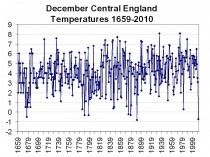
UPDATE: The December Central England Temperature which is one of the longest running record extending back to the Little Ice Age (1659), by the Hadley Centre as -0.7C. This is the SECOND COLDEST DECEMBER trailing only 1890 which came in at -0.8C. It was also the 20th coldest month in the entire record.

image
The enlarged is here. The data can be downloaded here.
Keep this in mind when you read the garbage pedaled by Samuelsohn and all the agenda-driven, rent-seeking liars below. Much more on this December to Remember early this week.

Saturday, January 1, 2011

That 97% Solution, Again (Canada’s National Post)


By Larry Solomon, The National Post

[SPPI Note: Also see the Dennis Ambler SPPI report.

How do we know there’s a scientific consensus on climate change? Pundits and the press tell us so. And how do the pundits and the press know? Until recently, they typically pointed to the number 2500 - that�s the number of scientists associated with the United Nations Intergovernmental Panel on Climate Change. Those 2500, the pundits and the press believed, had endorsed the IPCC position.

To their embarrassment, most of the pundits and press discovered that they were mistaken - those 2500 scientists hadn’t endorsed the IPCC�s conclusions, they had merely reviewed some part or other of the IPCC’s mammoth studies. To add to their embarrassment, many of those reviewers from within the IPCC establishment actually disagreed with the IPCC’s conclusions, sometimes vehemently.

The upshot? The punditry looked for and recently found an alternate number to tout - “97% of the world’s climate scientists” accept the consensus, articles in the Washington Post and elsewhere have begun to claim.

This number will prove a new embarrassment to the pundits and press who use it. The number stems from a 2009 online survey of 10,257 earth scientists, conducted by two researchers at the University of Illinois. The survey results must have deeply disappointed the researchers - in the end, they chose to highlight the views of a subgroup of just 77 scientists, 75 of whom thought humans contributed to climate change.  The ratio 75/77 produces the 97% figure that pundits now tout.

The two researchers started by altogether excluding from their survey the thousands of scientists most likely to think that the Sun, or planetary movements, might have something to do with climate on Earth - out were the solar scientists, space scientists, cosmologists, physicists, meteorologists and astronomers. That left the 10,257 scientists in disciplines like geology, oceanography, paleontology, and geochemistry that were somehow deemed more worthy of being included in the consensus. The two researchers also decided that scientific accomplishment should not be a factor in who could answer - those surveyed were determined by their place of employment (an academic or a governmental institution). Neither was academic qualification a factor - about 1,000 of those surveyed did not have a PhD, some didn�t even have a master�s diploma.

To encourage a high participation among these remaining disciplines, the two researchers decided on a quickie survey that would take less than two minutes to complete, and would be done online, saving the respondents the hassle of mailing a reply. Nevertheless, most didn’t consider the quickie survey worthy of response - just 3146, or 30.7%, answered the two questions on the survey:

1. When compared with pre-1800s levels, do you think that mean global temperatures have generally risen, fallen, or remained relatively constant?

2. Do you think human activity is a significant contributing factor in changing mean global temperatures?

The questions were actually non-questions. From my discussions with literally hundreds of skeptical scientists over the past few years, I know of none who claims that the planet hasn’t warmed since the 1700s, and almost none who think that humans haven�t contributed in some way to the recent warming - quite apart from carbon dioxide emissions, few would doubt that the creation of cities and the clearing of forests for agricultural lands have affected the climate. When pressed for a figure, global warming skeptics might say that human are responsible for 10% or 15% of the warming; some skeptics place the upper bound of man’s contribution at 35%. The skeptics only deny that humans played a dominant role in Earth’s warming.

Surprisingly, just 90% of those who responded to the first question believed that temperatures had risen - I would have expected a figure closer to 100%, since Earth was in the Little Ice Age in the centuries immediately preceding 1800. But perhaps some of the responders interpreted the question to include the past 1000 years, when Earth was in the Medieval Warm Period, generally thought to be warmer than today.

As for the second question, 82% of the earth scientists replied that that human activity had significantly contributed to the warming. Here the vagueness of the question comes into play. Since skeptics believe that human activity been a contributing factor, their answer would have turned on whether they consider a 10% or 15% or 35% increase to be a significant contributing factor. Some would, some wouldn’t.

In any case, the two researchers must have feared that an 82% figure would fall short of a convincing consensus - almost one in five wasn’t blaming humans for global warming - so they looked for subsets that would yield a higher percentage.  They found it - almost - in those whose recent published peer-reviewed research fell primarily in the climate change field. But the percentage still fell short of the researchers’ ideal. So they made another cut, allowing only the research conducted by those earth scientists who identified themselves as climate scientists.

Once all these cuts were made, 75 out of 77 scientists of unknown qualifications were left endorsing the global warming orthodoxy. The two researchers were then satisfied with their findings. Are you?

LawrenceSolomon@nextcity.com. Lawrence Solomon is executive director of Energy Probe and the author of The Deniers.
See SPPI blog post here.

Dec 30, 2010

December cold - unprecedented?

Posted on WUWT, December 29, 2010 by Verity Jones

BBC news has reported that 40,000 homes are still without water in Northern Ireland after the recent spell of freezing temperatures. Many have been without water for more than 10 days, and reservoirs are being drained due to an unprecedented number of leaks since the thaw. Calls to a few friends confirmed that, yes, it is bad - friends in Lisburn have been without water since Christmas Eve due to a frozen mains supply (i.e. not in their house); others in Belfast report low water pressure. Water is being rationed in places.

Was it really that cold? A search of the BBC site revealed “‘Baltic’ Northern Ireland” tucked away on the BBC NI news page. Castlederg in the West of the province recorded a low of -18C on 20th December - a new record. The thing about Ireland is that it sits on the very western fringes of Europe, bathed by the warm Gulf Stream (which is why Doug Keenan considered the 7000 years of Irish tree ring data so important that he pursued Queen’s University through FOI requests). Ireland, despite its latitude, just doesn’t do ‘very cold’ (or ‘very hot’ for that matter).

When I first got interested in climate I ended up corresponding with Tonyb about the temperature records of the Armagh Observatory in Northern Ireland. These stretch back to 1796. How does this current cold month compare with the historical record at Armagh? Was the recent cold unprecedented?

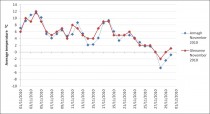
The currently incomplete December record for Armagh consists of raw data - three automated readings per hour. Rather than waiting until they calculate the December average I looked for nearby stations on Weather Underground and found Glenanne PWS, about 15km to the SW of Armagh. The average temperatures for the two stations over the month of November is plotted in Figure 1. This gave a good linear fit (R^2 = 0.889) with an offset � Armagh being on average colder by just over 1C.

image
Figure 1. Average temperatures for Armagh and Glenanne N. Ireland through November 2010 (enlarged here).

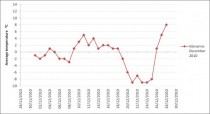
Figure 2 shows the December data for Glenanne on the same scale. Up to the 28th December, the monthly average is -0.86C. Mild conditions are expected for the next three days and, if I plug the forecast max/min (29th 8/6; 30th 8/4; 31st 6/2) into my spreadsheet to complete the month, the monthly average rises to an estimated -0.23C for Glenanne, remembering that this is an approximation for Armagh, which is typically colder.

image
Figure 2. Average temperatures for Glenanne N. Ireland through December 2010 (enlarged here).

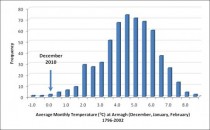
In the Armagh historical record, which I have for 1796-2002 from [1] the average temperature for December is 4.9C; January average is colder (4.1C). There are just two individual months colder than December 2010: January 1814 (-2.2C) and January 1881 (-0.9C) which puts this one as the third coldest on record at Armagh (2010 might yet tie with 1881 when the actual average for the month is published).

Coldest months according to the Armagh record:

1.January 1814 -2.2C
2.January 1881 -0.9C
3.December 2010 -0.2C
4.February 1855 0.0C, January 1963 0.0C
5.February 1895 0.2C
6.February 1947 0.4C
7.January 1985 0.5C, December 1878 0.5C

The list above also puts it in perspective with respect to other extreme years in living memory - most notably 1963 and 1947. According to the Armagh records none of the coldest months in these years saw such extreme cold as the Christmas period this year. The Arctic cold cut though the mild Atlantic air this year resulting in a monthly average 4-5C below normal (Figure 3).

image
Figure 3. Enlarged here.

Even without all the warming we have been led to expect wink December�s cold probably can be described as unprecedented. I’ll await with interest the actual December figures for Armagh (and those from the Met Office). As for this being caused by global warming - bull - it was just an extreme weather event. They happen. Go back >100 years and they happened then too.

Reference

[1] C.J. Butler, A. M. Garc�a-Su�rez, A.D.S. Coughlin and C. Morrell. Air Temperatures at Armagh Observatory, Northern Ireland, from 1796 to 2002 Int.J.Climatol. 25: 1055-1079 (2005) [Full paper]

UPDATE - from the Daily Mail (h/t Spectator in Tips & Notes).  Looks as if this will be a similar record in other parts of the UK too:

“Met Office figures show that the average temperature from December 1, the first day of winter, to December 28 was a bitter minus 0.8C (30.5F). This equals the record December low of 1890.”

The article goes on to point out that December is rarely the coldest month in the UK and a continued cold spell could beat the record set in 1683-84 of -1.17C.

-----------

The first of many official reports from around the country and world of a brutal, even coldest ever December is here in South Florida.

Dec 27, 2010

Wednesday, December 29, 2010

How Not to Help Blacks Find Employment (American Thinker)


By Robert Weissberg

As of November 2010, the overall unemployment rate for whites was 9.2%, but for African Americans it was 16.0%. Among those aged 16 to 19, the difference (including both males and females) was significantly larger -- 20.9% for young whites versus 46.5% for young blacks.  In job rich Manhattan, only one in four young (16-24) black males was employed in 2010. What is especially remarkable about these statistics is their intractability.  Since the 1960s and the War on Poverty, Washington has spent billions, everything from job training programs, to tax incentives,  to anti-discrimination laws to eradicate this gap, all to no avail.

Given a half century of failure, efforts to narrow differences have grown increasingly desperate. The latest is the federal government's attempt to equalize how black and white job candidates appear to prospective employers even if they differ substantially -- just ban employers from checking credit and criminal histories so as not to "unreasonably" disadvantage black job applicants.

The facts are straightforward. First, African Americans are far more likely to have criminal records than whites and, according to a Federal Reserve report, disproportionally also have credit problems -- repossessions, bankruptcies, wage garnishments, outstanding unsatisfied court judgments and high over-due credit card balances. Second, the internet (and other technologies) facilitates quick, inexpensive background checks of prospective employees (for example, here). Third, the courts have held that an employer screening of job applicants is inherently racially discriminatory if blacks are disproportionally excluded according to criteria that lack direct connections to the jobs (the principle of disparate impact).

Advocates of prohibiting this inquiry typically insist that (a) criminal and financial records are error prone, sometimes out-dated and often do not distinguish between serious and trivial infractions; (b) may reflect legal encounters decades back, often just youthful foolishness and (c) past bad behavior often has nothing to do with the sought after job. This view is graining traction beyond the federal government's long-standing campaign against disparate impact. Several states have explicitly banned employers from using credit histories in employment screening and a law was recently introduced (H.R. 3149) that would severely limit this practice nationally.

This anti-background check effort recently drew national attention when the Equal Employment Opportunity Commission (EEOC) sued the Kaplan Higher Education Corporation  for using credit histories to screen applicants, a widespread and growing practice among both private firms and the government itself. According to the suit, since January 2008 Kaplan has examined applicant credit histories and blacks have been disproportionately rejected. The EEOC not only demands that Kaplan cease this harmful practice but award back wages and benefits to those African Americans not hired due to credit troubles. Kaplan's defense is that it already has a diverse workforce, is an equal opportunity employer, and credit worthiness is relevant since Kaplan employees often handle financial matters.

Given the enduring gap between whites and blacks in obtaining jobs, the obvious question is whether this new approach will help African Americans get more jobs. Probably not; and, as in so many other well-intentioned interventions, it will widen gaps.

An almost prima facie case exists that criminal records and a poor credit rating tell a lot about a perspective employee, even for menial work. Past troubles provide clues about avoiding unwise risk, a capacity to plan, a willingness to follow rules, and otherwise behave prudently. These traits may have little to do with specific duties but no employer wants a workforce of deadbeats and former felons. Yes, there may be a weak link between failure to pay one's credit card on time and sticky fingers when sweeping the store floor at midnight without supervision, but there may be a connection, and given multiple applicants for the floor sweeper position, why risk pilfering? And, even if the initial job is unrelated to past problems, what happens when this employee asks for a promotion where the shaky background is relevant? Denying this request only invites litigation.

That these hiring criteria are racially discriminatory does not mean that they are economically irrational. Especially since good-paying jobs typically attract numerous applicants (especially in hard economic times), poor credit or a criminal conviction are perfect tie-breakers to sort out applicants. There are also supervision costs associated with monitoring employees with troubled backgrounds.  I owned a retail business for thirteen years, and this included hiring (and firing) dozens of employees, and predicting who will be an unsatisfactory employee, especially a thief, is difficult enough without knowing their personal histories, a situation compounded by many past employers refusing to say anything bad for fear of litigation. Given the paucity of information, I relied on the easily available applicant's history of paying utility bills, since I discovered that chronic no-payers often skipped work to resolve these crises. Nor did I trust those whose daily finances were desperate. To prohibit background checks is just one more attack on business.

Ironically, banning background checks may exacerbate black unemployment. If an employer has inadequate information about a prospective hire, he or she is forced to use crude proxies, and race is a convenient clear-cut proxy. So rather than risk hiring an ex-felon or chronic deadbeats, stick to whites or Asians. In fact, one study of this relationship found that employers were more likely to hire black males where they could perform background checks on past criminality. In other words, since most blacks have clean records, these "helpful" prohibitions were a liability for those who might otherwise be hired.

This ill-advised "help" is just one of many similar unhelpful government interventions. Prohibiting background checks only adds to an already heavy employer burden whose unintended impact is to price many blacks out of the job market. After all, what employer wants employees who can so easily sue for discrimination, real or imagined, on so many grounds (see here)? Similarly, why hire somebody whose educational credentials are less than bona fide thanks to government pressure on schools to make-the-number or admit unqualified applicants so as to redress historical inequalities?  And then prohibit the employer from independently testing job applicants if whites are likely to out-score blacks despite comparable credentials? Or why hire somebody who has been endlessly instructed that America is hopelessly racist and this racism must be exposed? No wonder that, as the private employment grows more competitive and employers have better choices, government itself has increasingly become the chief employer of blacks, since it lacks rivals with a superior workforce (see here, for example).

What might explain this counter-productive assistance? A cynic might claim that the hidden goal is greater dependency on government, but I'll leave that devious possibility to others. Personally I suspect that many "friends" of unemployed blacks lack any understanding how businesses can escape these economically harmful edicts.  In their mistaken view, help is just a matter of upping the pressure on white employers.  Yet, faced with edicts to hire blacks they are loath to hire, a firm might re-locate to largely whites areas, increase automation, hire sub-contractors immune to government mandates, eliminate or sell portions of the business, hire off-the-books and pay in cash, or outsource tasks overseas. These actions are, of course, increasingly commonplace, perfectly legal, and each may well contribute to the intractability of black unemployment.

Unfortunately, champions of boosting black employment refuse to acknowledge these avoidance strategies. They remain stuck in the white prejudice explanation and ignore the sound reasons behind these dreadful unemployment figures (see here). So, rather than counsel blacks how to use credit prudently, these "friends" attempt to create a fantasy world where employers cannot check troubled credit histories. But as the statistics show, the sham doesn't work. To invoke the mother of all clichés, with friends like this, who needs enemies?

Page Printed from: http://www.americanthinker.com/2010/12/how_not_to_help_blacks_find_em.html at December 29, 2010 - 06:49:53 AM CST

Monday, December 27, 2010

Obama Has Lost The World


Written by: Daniel Greenfield


After the 2010 elections, it’s not exactly news that Obama has lost America. But in a less public referendum, he also lost the world. Obama’s cocktail party tour of the world’s capitals may look impressive on a map, but is irrelevant on a policy level. In less than two years, the White House has gone from being the center of world leadership to being irrelevant, from protecting world freedom to serving as a global party planning committee.

Even the Bush Administration’s harshest critics could never have credibly claimed that George W. Bush was irrelevant. He might have been hated, pilloried and shouted about– but he couldn’t be ignored. However Obama can be safely ignored. Invited to parties, given the chance to show off his cosmopolitan sophisticated by reciting one or two words in the local lingo, read off a teleprompter, along with some cant about the need for everyone to pull together and make the world a better place, and then dismissed for the rest of the evening.

As a world leader, he makes a passable party guest. He has a broad smile, brings along his own gifts and is famous in the way that celebrities, rather than prime ministers and presidents are famous. On an invitation list, he is more Bono than Sarkozy, Leonardo DiCaprio not Putin. You don’t invite him to talk turkey, not even on Thanksgiving. He’s just one of those famous people with a passing interest in politics who gets good media attention, but who has nothing worthwhile to say.

The only countries who take Obama seriously, are the ones who have to. The leaders of Great Britain, Israel and Japan– who have tied their countries to an enduring alliance with America based on mutual interests and values, only to discover that the latest fellow to sit behind the Oval Office desk no longer shares those values and couldn’t give less of a damn about American interests. It’s no wonder that European leaders ignore him as much as possible. Or that Netanyahu visited America, while Obama was abroad. Or that Japanese politics have become dangerously unstable.

On the enemy side, the growing aggressiveness of China, North Korea, Iran, Hezbollah and Al Qaeda can all be attributed to the global consensus that no one is at home in the White House.And if no one is at home in the White House, then that’s a perfect time to slap the big boy around the yard. China is doing it economically, the rest are doing it militarily. They’re all on board with Obama’s Post-American vision of the world. But unlike him and most liberals, they have a clear understanding of what that means. The America of some years back, which actually intimidated Libyan dictator Khaddafi into giving up his nuclear program, without lifting a hand against him is long gone. So is the Cedar Revolution. Syria and Iran are back in charge in Lebanon. And in Afghanistan, the Taliban are laughing at our soft power outreach efforts.

Obama’s soft power approach emphasizes the ‘soft’ and forgets the ‘power’. It neglects even Clinton era understandings about the role of America in the world, and reverts instead to a Carter era sense of guilt that bleeds into hostility toward American interests and allies. While the rest of the world puts their own interests first, they act like a cog in some imaginary global community, turning and turning toward the distant horizon of international brotherhood. While China, Russia and most of the world walk down their backs and up their jellyfish spines, laughing all the way. And America’s allies gird themselves and prepare for the worst.

From the first, this administration has curried favor with America’s enemies by betraying and humiliating its allies. But these hideous acts of moral cowardice have not won Obama the approval of America’s enemies. Only their contempt. And a Nobel Peace Prize from a committee of elderly left wing Swedes, awarded not for any accomplishment, but for the lack thereof. For being a man without a country, a leader without a spine and a representative of America who gives no thought for the interests of that country.

Now that the Koreas stand on the brink of war, Iran continues its drive toward a nuclear bomb, Al Qaeda is going global, Hezbollah is on the verge of taking Lebanon and Mexico is on the verge of imploding– the impact of America’s absence on the global stage is all too clear. The countless cocktail parties and toasts have not changed the world. All they’ve done is highlighted the transition of the White House from world leadership to global party guest. Trip after trip has ended in photo ops and policy failures. Instead Obama is stuck dumpster diving into the futile quest for a Palestinian state, not because such an entity will make the world any better, but because it will make him look good.

Obama has no mandate at home, and he has even less of one abroad. America’s enemies do not fear him. Only our allies do. Kim Jong Il does not sit up nights worrying what Obama will do. Because the consensus in North Korea, Iran and the rest of the world is that the sea will rise, the sun will set and Obama will do nothing. Except maybe write a strongly worded letter, offset by some quiet backchannel diplomacy from his coterie of international left wing stooges reassuring the offender that, “No, Barry really isn’t mad at you. He’s just concerned. Really, really concerned.”

Liberal pundits mock the rough and ready style of conservatives like Reagan, Bush or Palin in world affairs, but what they fail to realize is that the over-educated naivete, trendy cosmopolitanism and buzzword rich approach of a Kerry or Obama come off as laughably pathetic on the world stage. Republicans might be hated, but they can’t be ignored. Democrats on the other hand are catspaws and pawns, fools who are so sure of their cleverness and determined to embrace every culture in the way that only the graduates of Ivy League institutions can, that any Third World vendor could twirl them around his fingers.

World leaders are rarely liked, but effective ones are respected. And effective world leaders don’t lead with appeasement, don’t compromise before the other side has even made an offer and negotiate on behalf of their country, rather than some intangible global consensus. They understand that they represent a country, not a popularity contest. They don’t travel abroad to be adored or be greeted with parades and gifts, but to achieve tangible results on specific issues. To do otherwise is not to be a world leader, but a celebrity who happens to have picked up a big title along the way.

To be a proper American president on the world stage, means choosing to be respected, rather than liked. Obama always chooses to be liked, rather than respected. Because respect comes from accomplishment and character, while ‘liking’ is a function of appearance and image. Aiming to be ‘liked’ is playing to Obama’s strengths. But being liked is irrelevant outside of an afterschool special. World affairs is not a networking seminar, it is a negotiation between countries who have billions of dollars and millions of lives on the line. And Obama has no idea how to play that game. Like the kid who never fit in anywhere, he’s still trying to be liked. And he’s willing to sell out American interests and allies to get the cool UN kids to like him.

Unfortunately Obama’s irrelevance is also America’s irrelevance. A Republican House of Representatives cannot do what Obama should be doing. And any attempt to show strength gets shouted down by the liberal punditocracy as treason and undermining the White House. As if anyone, anywhere could undermine Obama internationally as much as he undermines himself. The same liberals who considered Ted Kennedy’s treasonous offer of cooperation with the Soviet Union or Kerry’s trip to Latin American Marxist terrorists to be acts of courage, damn Republicans who supported allies in Ecuador and Israel as traitors. And so Obama must have a free hand to do it all on his own. To do what Kennedy or Kerry could have only dreamed of.

Obama has lost the world. He has made the country that he claims to represent into a shadow of its former strength and glory. And his irrelevance endangers American lives. Not just those of soldiers in war zones, laboring under restrictive Rules of Engagement, written so as not to offend Muslims. Not just those of Americans at risk for domestic terrorism under an Attorney General who sympathizes with terrorists, more than with Americans. But to everyone living in a world where countries like North Korea and Iran feel free to do what they want, where our economic rivals such as Russia and China advance their interests and their espionage, and where terrorists across the Muslim world grow in boldness and number because they have no one left to fear anymore. In America and around the world– Barack Hussein Obama endangers us all.

About the author:

Daniel Greenfield

Daniel Greenfield is a columnist born in Israel and currently living in New York City. He is a contributing editor at Family Security Matters and writes a daily blog column on Islamic Terrorism, Israeli and American politics and Europe's own clash of civilizations which can be found at Sultanknish.blogspot.com.

The Winner of This Year's 'Best Climate Predictor' Award (Clue: It Wasn't Al Gore!) (American Thinker)

December 27, 2010


By Howard Richman & Raymond Richman

Given the terrible beginning of winter in the U.S. and Europe this year, we ought to reward those who accurately predicted it and condemn those who got it wrong.  It's time to choose the winner of this year's "Best Climate Predictor" award.  There are five nominees:

  1. former Vice President Al Gore,
  2. California Governor Arnold Schwarzenegger, 
  3. the IPCC of the United Nations, and
  4. British astrophysicist Piers Corbyn.  (You say you've never heard of him?  You won't be surprised, once you've read his predictions, that the media have ignored him.)

Gore, Schwarzenegger, and the IPCC made their mark through their dramatic predictions of catastrophic sea level rise due to increased carbon dioxide in the atmosphere causing global warming.  Gore once predicted that sea levels would rise by twenty feet over the century.  Last year, Schwarzenegger unveiled a map showing world sea levels rising by 1.5 meters over the next century.  In 2001, the IPCC predicted that sea level would rise by three feet over the next century.  Their past predictions and the accurate satellite measurements are shown in the chart below:

The actual sea level rise over the last eighteen years is 1.85 inches, which works out to 10.4 inches per century.  This is similar to the 20th century's rise of 8 inches, but much less than the average rise of 4 feet per century for the last 10,000 years as glaciers left by the last ice age continue to melt.

Gore's prediction is clearly the worst of these three, yet he was awarded a million-dollar Nobel Peace Prize for bringing this issue to the attention of the world.  Schwarzenegger's prediction comes in second-worst, yet he is angling for a global warming spokesman job in the Obama administration.  The IPCC's prediction is third-worst, yet it just won a huge expansion of the U.N. bureaucracy at the Cancun Climate Conference. 

Piers Corbyn is the clear winner, yet he still works out of a drab office that the U.K. Daily Telegraph calls "undistinguished":

[T]his is the third tough winter in a row. Is it really true that no one saw this coming?

Actually, they did. Allow me to introduce readers to Piers Corbyn, meteorologist and brother of my old chum, bearded leftie MP Jeremy. Piers Corbyn works in an undistinguished office in Borough High Street. He has no telescope or supercomputer. Armed only with a laptop, huge quantities of publicly available data and a first-class degree in astrophysics, he gets it right again and again.

Back in November, when the Met Office was still doing its "mild winter" schtick, Corbyn said it would be the coldest for 100 years. Indeed, it was back in May that he first predicted a snowy December, and he put his own money on a white Christmas about a month before the Met Office made any such forecast. He said that the Met Office would be wrong about last year's mythical "barbecue summer", and he was vindicated. He was closer to the truth about last winter, too. [...]

He seems to get it right about 85 per cent of the time and serious business people - notably in farming - are starting to invest in his forecasts. In the eyes of many punters, he puts the taxpayer-funded Met Office to shame. How on earth does he do it? He studies the Sun.

Corbyn, like many other astrophysicists, has figured out that climate change is mainly due to extraterrestrial forces, including solar activity and cosmic rays, not carbon dioxide.  If you still believe in the theory that carbon dioxide causes climate change, click here to watch an excellent lecture by Jasper Kirkby at the Cern, one of Europe's most highly respected centers for scientific research.  Astrophysicists have discovered that changes in the rate of cosmic ray inflow cause climate change and that solar activity shields the earth from cosmic rays.  They haven't completely worked out the mechanism yet, but they think it has to do with cosmic rays causing cloud formation and clouds reflecting sunlight back into space.

Who says that climate change will not be catastrophic?  Starting January 2, President Obama's EPA will start enforcing its new regulation that American industries use the "best available control technologies" to reduce carbon dioxide emissions.  This could increase American energy costs sufficiently to choke off our economic recovery.

And don't forget that at the conclusion of last year's climate conference in Copenhagen, President Obama negotiated the Copenhagen Accord with China, Brazil, South Africa, and India as a framework for future negotiations.  That accord lets China opt out from any verifiable requirements but commits the developed nations to paying out $100 billion per year to the U.N. and to the participating developing countries.  It states:

In the context of meaningful mitigation actions and transparency on implementation, developed countries commit to a goal of mobilizing jointly USD 100 billion dollars a year by 2020 to address the needs of developing countries. This funding will come from a wide variety of sources, public and private, bilateral and multilateral, including alternative sources of finance. New multilateral funding for adaptation will be delivered through effective and efficient fund arrangements, with a governance structure providing for equal representation of developed and developing countries. A significant portion of such funding should flow through the Copenhagen Green Climate Fund.

So who is the best climate predictor of the year?  Obviously, that honor goes to Piers Corbyn and his fellow astrophysicists.  Who is the worst?  Al Gore, followed closely by Gov. Schwarzenegger and the U.N.'s IPCC.  The last entrant's mischief-making has already cost the U.S. billion of dollars and brought Spain to the edge of bankruptcy, and it promises to make China the principal beneficiary of any further action.  President Obama and the U.S. Environmental Protection Agency appear determined to bankrupt the U.S. and send what remains of U.S. manufacturing to China.

The authors maintain a blog at www.idealtaxes.com, and co-authored the 2008 book Trading Away Our Future: How to Fix Our Government-Driven Trade Deficits and Faulty Tax System Before it's Too Late, published by Ideal Taxes Association.

Page Printed from: http://www.americanthinker.com/2010/12/the_winner_of_this_years_best.html at December 27, 2010 - 07:55:25 AM CST

Wednesday, December 22, 2010

Seeds of Financial Catastrophe (American Thinker)

December 22, 2010


By Fred N. Sauer

Although our economy is still struggling to recover from what is now the longest recession since the Great Depression, the latter was a much greater catastrophe.  From 1929-1939, unemployment reached as high as 25%, industrial production dropped 46%, wholesale prices fell 32% and foreign trade dropped 70%. 

There is a general consensus about one of the most significant contributing factors to the financial crisis of the Great Depression:

In the nineteenth and early twentieth centuries, bankers and brokers were sometimes indistinguishable.  Then, in the Great Depression after 1929, Congress examined the mixing of the ‘commercial' and ‘investment' banking industries that occurred in the 1920s.  Hearings revealed conflicts of interest and fraud in some banking institutions' securities activities.

Commercial Banks for the most part are lenders to persons and businesses whose borrowing requirements are too small to utilize public markets.  Commercial Banks have to have detailed personal knowledge of their borrowers.  And they lend to local borrowers in their local communities. 

Investment Banks, on the other hand, tend to raise money for larger businesses from the sale of common and preferred stocks and longer term corporate debt.  The criteria for borrowing in the public markets are more rigorous than those of local bank lending.  Therefore, it is much more expensive and complicated to qualify for this type of lending.  Investment Banks also tend to make markets in the securities they issue or those that are already outstanding in the public market.  This is all done by brokerages, the buyers and sellers of public securities for private and institutional investors.  

To remedy these problems, Congress passed a historic piece of legislation:

The second Glass-Steagall Act (the Banking Act of 1933) was a reaction to the collapse of a large portion of the American commercial banking system in early 1933.  It introduced the separation of bank types according to their business (commercial and investment banking), and it founded the Federal Deposit Insurance Corporation for insuring bank deposits.

The most important part of the Act was the creation of the Federal Deposit Insurance Corporation (FDIC).  This insured deposits placed in commercial banks from the risk of loss in the event of the failure of a commercial bank.  Depositors are in effect "lenders" to banks which relend the deposits to other borrowers.  In the absence of such insurance, when the banking system started to collapse in 1933, depositors' funds were wiped out.  And so, the money supply shrank considerably. 

In separating commercial banks from investment banks, Federal Deposit Insurance was not provided to investment banks, and for what used to be obvious reasons, commercial banks are considered less risky businesses than investment banks.  Therefore, all other things being equal, investment banks will always have to pay a higher rate of interest to borrow money than commercial banks have to pay their depositors. 

When you open up your bank statement, whatever the amount of your balance, about 60-80% of it has to be paid off with loans made to borrowers, while the rest is covered by required reserves and other sources of income.  Everyone with a positive balance on their bank statement is in fact an invisible partner to a business or individual who has borrowed money from the depositor's bank using the depositor's funds.  And as we said, bank loans historically have not been marketable because typical bank borrowers could not meet the market's qualifying criteria. 

And so, commercial banks used to be experts in knowing their customers, knowing their collateral and getting personal guarantees to provide their successful history of making unmarketable loans.  These then benefit the borrower, the depositors, and their stockholders.  And banks usually held these loans to maturity and everyone involved lived with the consequences. 

By 1970, something new popped up called Asset Securitization.  In this process, batches of similar loans are assembled so that they would look like a single larger loan with a composite of the individual loans' characteristics.  The larger loan could then be economically prepared for trading in public markets.  The Federal Government started to use this process to make mortgages for housing more affordable. 

In February 1970, the U.S. Department of Housing and Urban Development created the transaction using a mortgage-backed security.  The Government National Mortgage Association (GNMA or Ginnie Mae) sold securities backed by a portfolio of mortgage loans. 

In the case of Ginnie Mae securities, no matter what the quality of the individual mortgages in the pool amounted to, when the securities where combined into a single security issued by Ginnie Mae, their value was enhanced by the existence of the implied guarantee of the Federal Government (i.e., the United States taxpayer).  Through Ginnie Mae purchasing and securitizing pools of mortgages, banks could unload their portfolios of mortgages.  This would result in a further loss of accountability over the quality of the mortgages originated.  When Commercial Banks held mortgages to maturity, they were more careful about their quality.  In a short period of time, Asset Securitization allowed commercial banks to offload bad loans over which they otherwise had institutional responsibility to other investors and depositors. 

Not surprisingly, banks started pooling together other types of bank loans for securitization: 

...In 1985, securitization techniques that had been developed in the mortgage market were applied for the first time to a class of non-mortgage assets -- automobile loans.  A pool of assets second only to mortgages in volume, auto loans were a good match for structured finance; their maturities, considerably shorter than those of mortgages, made the timing of cash flows more predictable, and their long statistical histories of performance gave investors confidence... .

The first significant bank credit card sale came to market in 1986 with a private placement of $50 million of outstanding bank card loans... .  Sales of this type - with no contractual obligation by the seller to provide recourse - allowed banks to receive sales treatment for accounting and regulatory purposes (easing balance sheet and capital constraints), while at the same time allowing them to retain origination and servicing fees... .

The first public Securitization of Community Reinvestment Act (CRA) loans started in 1997.  CRA loans are loans targeted to low and moderate income borrowers and neighborhoods.  

These would become the fodder for the sub-prime mortgage debacle we just experienced.

Here is a short course on this Asset Securitization, and how it is attractive. Commercial Bank "A" has 1,000 individual mortgages.  There is no market for just one of them.  But there is a market for 1,000 securitized into a single security whose composite yield is 6.5% and composite duration is 20 years.  Investment Bank "B" knows that they can sell a $100,000 pool of securitized mortgages to a high yield mutual fund "C" for a yield of 4.5%.  Commercial Bank "A"'s $1,000,000 pool has a monthly cash flow, principal and interest of $7,455.74.  Investment Bank "B" knows that they can sell this pool of mortgages for a yield of 4.5%.  In order to induce Commercial Bank "A" to sell the pool to it, Investment Bank "B" offers to pay Commercial Bank "A" $1,083,860 and will then give the pool a yield of 5.5%.  Commercial Bank "A" makes a profit of $83,860.   When Investment Bank "B" resells the same pool to the high yield Mutual Fund "C", which only needs a yield of 4.5%, it receives $1,178,494 from the high yield Mutual Fund "C".  Therefore, Investment Bank "B" makes a profit of $94,634, and so on.  In addition to the initial profit, there are placement, distribution and administrative fees to be earned.  This is quicker money than holding mortgages to maturity. 

Chart 1-Value of 1,000,000 Pool of Mortgages

Accountability and responsibility declined as securitization increased with everyone earning fees on originating and issuing securitized pools of almost anything.  Both the commercial banks and investment banks love this environment.  They make a lot of fees and turn over their capital rapidly.  And each one of them wanted to get into each other's business.  Unfortunately for them, the Glass-Steagall Act stood in their way.  Then in 1995, everything started to change, under the leadership of a former Goldman Sachs CEO:

Robert E. Rubin, secretary of the Treasury, recommended that Congress pass legislation to reform or repeal the Glass-Steagall Act of 1933 to modernize the country's financial system.  In testimony before the House Committee on Banking and Financial Services, Rubin said Clinton administration proposals would permit affiliations between banks and other financial services companies, such as securities firms and insurance companies... .

...Rubin said supporters of the act today say Glass-Steagall is necessary to protect the federal deposit insurance system. 

‘However,' said Rubin, ‘the banking industry is fundamentally different from what it was two decades ago, let alone in 1933.'  He said the industry has been transformed into a global business of facilitating capital formation through diverse new products, services and markets.  ‘U.S. banks generally engage in a broader range of securities activities abroad than is permitted domestically,' said the Treasury secretary.  ‘Even domestically, the separation of investment banking and commercial banking envisioned by Glass-Steagall has eroded significantly.'

Rubin said Glass-Steagall imposed unnecessary costs and made providing financial services less efficient and more costly.  He said the act can ‘conceivably impede safety and soundness by limiting revenue diversification.' 

The recent financial crisis completely obliterated every intended meaning of this financial elite member's statement. The repeal of the Glass-Steagall Act allowed Citicorp and Travelers Insurance Company to merge in 1998.  This merger ignited a wave of other commercial banks absorbing investment banks.  The amount of government aid to these banks and financial institutions, including aid provided by the Treasury Department through TARP and the Federal Reserve, aggregated over $1 trillion through 2009.  This and the near-collapse of Citigroup, and several other major financial institutions, demonstrate the removal of the Glass-Steagall Act was a complete and utter catastrophe for America. Nonetheless, the recently passed Dodd-Frank Wall Street Reform and Consumer Protection Act of 2010 does not correct this
Fred N. Sauer is an American patriot, St. Louis resident, and businessman whose blog can be found at www.americasculturalstudies.com.

Page Printed from: http://www.americanthinker.com/2010/12/seeds_of_financial_catastrophe.html at December 22, 2010 - 06:57:44 AM CST

Wednesday, December 15, 2010

To Sexist AP, HuffPo Inanely Bashing Palin Is More Important Than Helping Haiti (Redstate.com)


Posted by Lori Ziganto (Profile)

Tuesday, December 14th at 11:30AM EST

136 Comments

Every time I think that the “Press” can’t sink any lower than the rock bottom they’ve already hit, they somehow manage to burrow themselves further into the earth’s mantle. As is so often the case, this most recent gutter-dwelling example has to do with Sarah Palin, who dared to go on a humanitarian trip to Haiti. This does not suit! You see, how can the Press feel all holier-than-thou and better than Sarah Palin – and her fellow rubes – when she is out helping people in Haiti, while they are sitting at home and sipping their soy lattes? I mean, you can’t even see their super awesome and caring “cause ribbons” in print. Plus, she’s just a girl and not the right kind of girl; she embraces motherhood and doesn’t hyphenate her name. She doesn’t even limit herself to caring only about topics that women are assigned to caring about by the left. This aggression cannot stand.

So, they fall back on sneering contempt, mixed with insanity and outright lies. While that is what they are best at, even that no longer works. A funny little thing happened to their ability to do so: the absolute moral  insolvency of the Fourth Estate is now apparent to most and citizens are now finding the truth for themselves. This again happened on Monday, when the AP ran this picture and caption:

“Former Alaska Gov. Sarah Palin, center, has her hair done during a visit to a cholera treatment center set up by the NGO Samaritan’s Purse in Cabaret, Haiti, Saturday, Dec. 11, 2010….”

What the AP photographer purposely neglects to mention is that the woman “doing Palin’s hair” is her daughter, Bristol. She is clearly seen in the following photograph, as also noted by Free Republic:

In other photos from Saturday, Todd and Sarah Palin’s white, brunette, eldest daughter Bristol, who accompanied her parents on the trip to Haiti, is wearing the exact same clothing and ponytail as the “hair stylist” in the AP photo.

That’s right, what the Palin-hating AP and others fail to report is that the “hair stylist” is Bristol Palin.

Bristol Palin was fixing a loose clip or an errant strand of hair for her mother. The photographer quite clearly knew that, having taken the picture and having actually looked through the lens at the people whose photo he was taking. He managed to identify Todd Palin, yet purposely did not identify Bristol.

There are a couple of things clearly on display here. Firstly, the oh-so-tolerant and loving Left is anything but. It’s far easier to mock and bash Sarah Palin than to actually, you know, do anything to help. Secondly, their blatant sexism, particularly against conservative women (femininity with smarts and strength is icky), has once again been exposed for all to see. I suppose we are to just be grateful that the media didn’t get all atwitter, contemplating boob jobs, like they did last time Palin was photographed in a t-shirt. The Daily Mail picked up on the “let’s totally lie to fit our delusional narrative” line with an article titled Ready for Her Close Up…Sarah Palin Lands in Haiti (where they don’t care what her hair looks like).

Michael Shaw at The Huffington Post went one further with one of the most dreck-filled “articles” I’ve read in a good while. And that’s saying something. I hesitate to quote too much of it, just to be safe, on the off-chance that cuckoo-pants may be catching. But, here are some highlights lowlights:

If I find the fantastically clever Sarah Palin to be one of the shallowest and blatantly self-serving politicians, err, political celebrities I’ve ever seen, it doesn’t stop me from taking pause upon seeing these AP shots from Franklin Graham’s cholera treatment center in Haiti.

Damn right it’s revolting seeing Sarah getting her hair made up like this field hospital is her movie set –

I’ll translate: Shallowest, self-serving and political celebrities – that’s all code for dares to be attractive and feminine.  In the mind of a leftist, women really shouldn’t be taken seriously. They are only tolerated if they allow themselves to be useful idiots and talk the leftist talk and walk the leftist walk. “Revolting seeing Sarah getting her hair made up” – this is also code for “she’s just a dumb broad.” However, it’s also a case of projection. What’s really revolting is that someone sitting on his fanny is mocking someone who is visiting and trying to bring aid and comfort to cholera patients at a field hospital.

Shaw then drifts into even more inane, and insane, territory. I know. But, it’s true:

And then, the multiple shots of Sarah sanitizing and washing her hands suggests the former Gov is primarily concerned, above all humanitarian else, about catching something.

There are two questions I can’t quite answer, however. 1.) Compassion notwithstanding, could these exact same images have been created if it was Biden, Bill Clinton, Hillary or Nancy Pelosi moving around this camp with media in tow over the same afternoon?

She’s concerned about “catching something”? She’s there. Where are you, Mr. Shaw? Furthermore, I’m no fancy-pants journalist who talks out of my cushy and judgmental hindquarters. So, I did a little something called a google search to confirm my common sense (common sense is hard for the Left) suspicions; washing and sanitizing hands after being in contact with people infected with cholera is a way to, you know, stop the transmission and spreading of cholera. It’s what one is supposed to do.

And I’ll answer your idiotic question, Mr. Shaw. No, those same images would not have been created, were it Biden or Bill Clinton. Nor even Barack Obama, if you could get him off the golf course long enough. And, even then, he’d probably just outsource to Bill Clinton again, anyway. No such images nor captions would be created because you’ll never see a caption purposely meant to diminish or demean, based on gender, underneath the photo of a male politician. A photo of Obama, say, having his tie fixed, would never say something  like “Barack Obama has wardrobe styling done during visit.”  And any pictures of Joe Biden having his hair fixed would be photos taken at the Hair Club for Men.

Plus, Sarah Palin is the one with the spine; Bill Clinton, in fact, canceled his planned trip to Haiti because it was too scary.

Shaw goes on to try to explain away the fact that the “hair stylist” in the picture was revealed to be Bristol by claiming that somehow shows media bias in favor of Palin. Or something. I’m not really sure, as I lost my cuckoo-pants to English dictionary.

In any event, keep lying and bashing, Mr. Shaw and your fellow travelers. Lie and bash like the wind.

It only makes Palin stronger. I’m sure the people of Haiti are taking comfort from that strength. I’m also certain that she, and all the others on this humanitarian trip at whom you sneer from the comfort of your own sanctimony, will do more in one day to aid others than you will do your entire life. See, people can’t really subsist on shiny, self-congratulatory “cause ribbons.”

Nor on Smug ™.

Sunday, December 12, 2010

Why Palin Makes Liberals Nuts


By weholdthesetruths

It's all about ego.

Well, ok, no it isn't. I just thought that little bolded lead-in would get your eyes open a slight bit wider. I don't know if it worked, and I don't care, I write to amuse me, not necessarily you (though if I do entertain, inform, inspire, anger, annoy, or otherwise prompt you to think, so much the better).

Never has American society been so divided - and it's not between the haves and have-nots, as much as it is between the self identified 'intelligent' and most everyone else. Oddly enough, we all live and work and eat and drive and shop and vacation in much the same places and ways and for the same things, but somehow, we've come to see it all different.

For generations, children grew up with an expectation, and even hopes, of being like their parents. In America of old, not only did they dream of it, but they did it, and they did BETTER than their parents. I think we expect it, and I don't think that's a bad thing. But somewhere, it seems to have gone awry. As knowledge has increased, children often have the chance to learn much more than the parents did. The universe of knowledge about science, biology, physics, and many other things has expanded in a way that makes the word "dramatically" seem pitifully weak, but for now, it stands.

And somewhere along the way, there became the inevitable, when children came to believe themselves wiser than than their parents. In the old days, when your ability to accomplish concrete things, like hunting, fishing, growing, building and so on, was the key to success in life, those children who failed to learn from parents often did poorly, as the knowledge needed came ONLY from the generations before. Children who ignored their parents were generally unsuccessful, and often attended the University of Hard Knocks before they wised up, and ended up emulating much of what their parents knew and taught.

But today, our financial success in life is not nearly so much dependent upon broad practical skills passed from generation to generation, it's more dependent upon learning some specialized skill and exploiting it for gain. You may think that's good or bad, and there's arguments for both, but either way, it's hard to argue differently. Parents taught frugality, but it seemed that even the non-frugal did ok. Parents taught to be patient and to restrain yourself and be prudent and all those other things, and yet, we saw the impatient and imprudent prosper.

And so questioning and often outright rejecting the mores and traditions of our parents became a generational pastime, one now entrenched and generations old. There are multiple versions of this... Political, meaning "progressive" and "conservative" and there's social versions as well, and financial versions and so on. It was a very progressive thing in 1778 to be against slavery, but today, conservatives are adamantly opposed to it. Meaning that issues or matters can move from one spectrum to other. But the moral case against slavery was just as true in the 1700's as it is today. This is a case of a truly conservative idea becoming so far outside of the publicly accepted, that it could be labelled "progressive". But the right and wrong never changed.

The Founders had a truly revolutionary idea, one we could probably reasonably appropriately label as "progressive", that government would serve, not rule, the citizens. One where the idea of a centralized government ordering the people around to please the whims of those who hold office was so foreign and so repugnant it would be codified into law as illegal. Truly, in that era, it was an idea that was far and away outside the "norm". But it was a truly great idea, one worthy of the ages.

It is a lot of generations from 1788 to now, and in that time, social change has brought us that same ever evolving generational change. Now it is "progressive" to want a government with the power to control every aspect of our lives, to limit people's income, wealth, economic activities, and control relationships between even employee and employer. And, to take economically from those not poltically favored, and give material or financial benefits to those politically favored by politicians.

The reason the US went to war with England, was over that kind of centrally directed economic control, forced upon us by the King. The colonies rebelled to escape such centralized powers.

But what we face, is that a few generations back, it was much harder to visibly discern the array of differences between us. Today, they are stark. Academics claim that morality is based upon political ideology, and supposedly great thinkers laud them for their innovative approach to complex problems. The Colonists rejected the King, precisely because the King claimed that what was moral and just was defined by what the King wanted. To those of us who hold other views, there is negligible difference between modern progressives and the kings of yore, for obvious reasons.

Conservatives look at economics in a very utilitarian way. Wealth is created by undertaking business ventures. Unlike the 1700's, growing food without large capital investment will not make you wealthy. It is impossible to actually survive in a subsistence mode today, the taxes alone will make you lose everything you have, and you'll be left without the means of even subsistence farming. Nothing any individual can do, without the interaction of, the conduct of economic trading and transaction - otherwise known as business, will generate enough wealth to provide our needs and wants. Everyone needs a job, and jobs are created by private enterprise. Very simple equation. Very fundamentally sound and time tested for many, many centuries.

As a conservative, I hold onto the things that are time tested and true. "Open marriage" is a bust. High risk debt is not secure. Deep debt is an entrapment. Big, controlling government is a massive burden too large to bear and still be individually prosperous. Poverty is bad. Dependency does bad things to people's thinking and will. None of these ideas require or even depend upon academic thinking or education to establish. They are simply the accumulated wisdom of the ages, about things that do not change.

But progressives do not accept these things. Not universally, of course. Progressives may be conservative about marriage, for instance, but be wholly radical about government. It's a free country, of course. But progressives, by and large, have come to despise the "old fashioned", and have instead, embraced the "new". And by "new", I mean the untested, the untried, the unproven. Or, at least not in the way they want to do them. They pride themselves in rejection of the old and staid and embracing the "smarter" and "better" "new" ideas that are better and smarter than the old and dull stuff my parents and maybe their parents or grandparents or maybe great grandparents thought was pretty solid and true.

Progressives have a burden to change everyone else to be like them. They embrace the new and innovative, they love "change", sometimes just for the sake of change. And they blame all the problems on the old ways of doing things. Which brings us to the intractable debate, the argument that expresses itself in the Sarah Palin divide.

Liberals, progressives, Democrats, whatever the self identity is that brings them to despise Palin, it's because she is the most visible source of antagonism. Unashamedly, with a smile, and sometimes with humor, she, without recognition of their superior intellectual status, tears them down, dismisses them without a second thought, and champions the ideas that they have so carefully spent time and energy attempting to discredit.

For decades, the arguments have mostly been limited to a few Republicans vs progressives. But political parties are soulless things, and so the GOP had drifted far their way, mostly giving into their relentless activisim. Politicans rarely stand too firmly on principle, and as such, are easily drifted with the tide. And the "tide" it is. Because progressives have sought with fervent ardor to become the teachers, the legislators, the journalists, the media, the entertainers, the ones who control the conversation. Progressivism isn't based upon logic and facts and reason, it's based upon a reflexive rejection of traditional things and an embrace of the new and exciting or even just "different", for sake of being "ahead" of the generations previous.

It can all be predicted, you know. The labelling as dumb - after all, she is so dumb, she doesn't acknowledge that progressivism is better. She doesn't know her ideas have lost, and thus champions them with a straight face and no reservations. She doesn't act like a product of an elite school, where "education" has become an indoctrination - perhaps even programming - into progressivism on every subject. Professors and administrators feel free to degrade those who fail to conform. Pundits on TV react with derision and insult toward those who don't conform.

There have been other targets, of course. Some we know still, some forgotten. Mostly because they folded under the withering barrage against them, or compromised, or found themselves silenced by efforts of those who wished to shut them up. But Palin's the exception. Palin has reached into the heartland, where progressivism isn't the standard of thinking. She speaks for the majority, in an unabashed, proud and self assured way. She is, to put it in crude terms, the massive boil on the face of a model.

And, so they get angry. Irritated, hateful, enraged, deranged, and whatever other terms fit the passionate and negative reaction to one who has so much popular support, who simply refuses in any way, to be cowed. Even more irritating, she turns their criticism and anger into additional public support and popularity. Progressives thought by making her the face of conservatism that they would marginalize it. Instead, it backfired. They attacked personally, the conservatives, by making Palin the proxy, and conservatives, for the first time, didn't roll over and die. Nor did Palin. Instead, the more they throw at her, the more she generates support for herself and the ideology attacked by proxy.

Liberals, progressives, whatever term you wish to use, are by definition, followers. They follow the ideas of some thinker, some writer, some figure. They have their icons, and thier 'wisdom' consists of the writings by and speeches from, and ideas from radicals from various generations. For them, history starts at their adulthood and they have the answer for all the vexations of humanity. It never occurs to them that far wiser have tried far harder than they have ever dreamed of. Our status as an incredibly prosperous country has provided the funding, the discretionary income and time, for them to experiment, mostly without consequence, on our people and country, and they are wholly taken back, that when a real crisis occurs, the people they thought were following them have been reluctantly tolerating them. And along comes someone like Palin, who represents every, and I mean EVERY thing they fight so hard against, and rides a wave of popularity to celebrity status.

Political critics of Palin say she's running a celebrity event. She's trying to be celebrity. Perhaps so. Analysts of Palin insist she can't run for President, because she's too caught up in being a media star. I think Palin has an instinctive grasp of things far better than she or most grasp. What more of a lightning rod could Palin be, than to subvert media and celebrity to campaign for conservatism? You could not possibly be more "in your face" than to use the very tools and venues of progressivism to promote conservatism. Conservatives were supposed to be mind numbed robots, remember, following Rush on AM radio. It was a nice, neatly packaged lie that progressives told themselves. Conservatives don't follow anyone... Except perhaps Jefferson and Washington and Jesus and other unknowns in today's media. They just assumed that conservatives followed, just as they follow.

Palin's not dumb. Not ignorant. She is the child of two passionate teachers. She knows more about biology and physics and math and history and geography and the list goes on, than the vast majority. She knows her place and our place in history. And she knows where we, Americans came from. And that exceptionally bright "city upon a hill" and "beacon of liberty" to the world. That's the kind of teaching that real teachers taught. It may be "ignorance" as defined by progressives. But it's the wisdom of age, time, and history.

And just when they believed the battle to overcome history and wisdom was won, along came the most unlikely hockey mom from a dusty and un-sophisticated town, in the most primitive state, championing the most unprogressive ideas, and in doing so, taking that victory and flushing it down the toilet. Instead, the TEA Party showed up. It's the worst nightmare of the intellectual, the elite, the progressives. Thank God. I thought for a while the darkness would win. We had forgotten that even a hockey mom from Wasilla can beat back the darkness. We fear it no more.

Saturday, December 11, 2010

Sarah Palin: America By Heart, A Review


Posted by Melissa Clouthier on Dec 5 2010

Over Thanksgiving, I read Sarah Palin’s new book, America by Heart : Reflections on Family, Faith, and Flag. My first thought after finishing it? Wow, that was good. My second thought? If someone gripes about her from now on, I’m going to respond,”Have you read her book?” When the opinionated person says, “No.” I’m going to say back, “Talk to me after you’ve read her book.”

Before getting to the guts of the tome, I would like to address one thing that irritates me: When writing about Sarah Palin, it is de rigeur for friend and foe alike to use one’s criticism (and I mean criticism in the dictionary sense; here is the definition: Criticism is the judgment of the merits and faults of the work or actions of one individual by another. To criticise does not necessarily imply to find fault, but the word is often taken to mean the simple expression of prejudice or disapproval) as either an endorsement or “hit job” of the person.

Even reading the book implies a certain fan-like behavior, a friend informed me. This notion is offensively absurd, but then, we live in absurd political times.

Here is what I believe about Sarah Palin: She is a political force of nature. She should be taken seriously. She has a tremendous amount of political capital and would be a contender if she chooses to run in 2012.

In addition, Palin has driven the political debate since President Obama has taken office. She, more than any other Republican, has been a philosophical counter-point to Barack Obama, and really, to the establishment Republicans in Washington, D.C.

Her book deserves to be read on all these grounds. And anyone who claims to be an intellectual but refuses to engage intellectually by refusing to read her book deserves to be ignored.

To the book.

You know how your mom told you that in polite company one does not discuss sex, politics and religion, and for good modern measure, race? Evidently, no one had that conversation with Governor Sarah Palin. Her book covers all the unspeakables and takes the issues on in her characteristically direct manor.

The tone of the book is refreshingly open. That is, she addresses many challenging and politically incorrect topics with alacrity. Her opinions will make many people angry, once they summon the gumption to read them. Her opinions will force other politicians to answer difficult questions, should the press have the gumption to ask them.

A sampling of quotes:

Parenting: Page 117: “When it comes to raising good citizens, all ‘lifestyle choices’ are not created equal.” Governor Palin notes this in the context of the Murphy Brown and Dan Quale debacle two decades ago.

Feminism: Page 135: ” In the name of liberating women, modern feminism has wrapped us in a one-size-fits-all strait jacked of political correctness.” And on Page 140: ” …somewhere along the line feminism went from being pro-woman to being effectively anti-woman.”

Abortion: quoting Alice Paul: Page 157: “Abortion is the ultimate exploitation of women.” Mary Vitale calls the book a “Pro-Life Family Story.”

Self-esteem movement: Page 167: “Our basic understanding of self-discipline and our ability to work hard for an often distant reward are formed early, in strong families and communities that don’t confuse hard-earned self-esteem with unearned self-regard.” And on Page 179: “I believe in a humbler, less self-involved America.” And on page 166: “In fact, we may be creating a generation of entitled little whiners.”

Government: Page 75: “A ‘boundless field of power’ — sounds like it could be a description of the current flood of legislation coming out of Washington. What we’re seeing today is the inevitable result of national leaders who have forgotten the fundamental wisdom of the the Tenth Amendment.” And on Page 72: “In practice, I’ve always interpreted the Tenth Amendment to mean that the best government is government that is closest to the people.”

Freedom: Page 12: “For me, this is the essence of freedom: to be a child of God whose God-given rights and responsibilities are respected by her government under the Constitution.”

Slavery: Page 29: “[The Framers] did more than just kick the can down the road. They produced a document that one of the delegates at the Constitutional Convention, James Wilson, said succeeded in ‘laying the foundation for banishing slavery out of this country,’ even thought he regretted that ‘the period is more distant than I could wish.”

Hollywood portrayal of the military: Page 42: “What makes this reflexive anti-Americanism hardest to swallow is the fact that it is our troops–these men and women who are being portrayed as unwitting (and witting) agents of greed and evil on the big screen–who make the entertainment industry possible.”

Sarah Palin writes an ardent defense of John McCain and writes passionately about the military. She relates the embarrassment and difficulty of having a child who ended up pregnant as a teen. She tells some personal anecdotes while winding her philosophy about America through the threads.

Most of all, Sarah Palin proclaims her devotion to America and asserts its exceptional place in the world.

In short, America By Heart is the anti-Audacity of Hope.

Far from believing that America must be remade, she believes America must be renewed. She cites philosophers, thinkers, movie makers, politicians and historians. Far from sounding ignorant, she sounds well-read and informed. She lays out her beliefs in a clear and straight-forward manner. Far from being a dithering confused empty suit, she seems centered and sure.

If there was a weakness in the book, it was in the lack of concrete policy solutions, though I’m not sure that was the purpose of her book. At one point, she beautifully laid out the problem of the loss of the nuclear family and how it’s destroying the social fabric of society. She cites a lengthy piece from James Q. Wilson (page 119). Here’s a snippet:

“To avoid poverty, do three things: finish high school, marry before having a child, and produce the child after you are twenty years old. Only 8 percent of people who do all three will be poor; of those who fail to do them, 79 percent will be poor.”

Then Palin says (page 120):

“Two-parent families do matter when it comes to raising kids to be happy and productive citizens. Does that mean we turn our backs on girls and women who find themselves pregnant with no man in their lives? Of course not. I would be the last person to advocate that.”

Her statement begged the questions: What then, are we to do with this single parenthood epidemic that is a cancer on our society? How do we shore up the family? What is the government’s role?

It would seem, that generally speaking, Sarah Palin believes the government is doing too much and far more than it should–for everyone. She speaks directly to the arrogance of the current crop of political leaders saying (page 179):

“There is narcissism in our leaders in Washington today. There’s a quasi-religious feeling to the message coming from them. They are trying to convince us that not only are they our saviors, but that we are our saviors–not hard work, not accomplishment, just ‘believing in ourselves’ and what we can accomplish together through government. As candidate Obama proclaimed on Super Tuesday 2008, ‘We are the ones we’ve been waiting for, we are the change that we seek.’”

She continues:

“Everything that is worthwhile comes through effort. There is no free lunch. Anybody who tries to tell you otherwise is selling something–usually something paid for by your tax dollars.”

In the next chapter she tackles morality and religion. She sees freedom as intrinsically linked to the Sacred. One of my favorite lines from the book can be read on page 192. She says, “In other words, tyranny can thrive whether people are good or bad, but preserving freedom takes preserving virtue.” Here’s the rest of the paragraph:

“You can look, but you would have trouble finding an American from the founding generation who didn’t share this belief. This sentiment, so controversial today, was imply taken for granted at the time. The Founders deliberately and self-consciously constructed a government based on the belief that religion was at the root of the personal and public virtues necessary to sustain freedom. And they weren’t just being pragmatic. Despite the identification of many with Enlightened Deism, an eighteenth-century belief that strove to reconcile religion with reason, they all had genuine faith and genuinely believed that following its dictates was for the better, both in this life and the next.”

Sarah Palin believes a moral society is the underpinning of a free society. She disagreed with the JFK Houston speech (which got her in trouble with the Kennedy clan, evidently). She quotes Thomas Jefferson, “The God who gave us life gave us liberty at the same time. The hand of force may destroy, but cannot disjoin them.” (Page 195) “I love those words,” enthuses Palin.

Most Americans who read America By Heart will find little to object to therein. The Smarty Pants Set™, on the other hand, will despise the book. Sarah Palin takes aim at their cherished premises and counters them one by one.

In addition, Sarah Palin manages to write a highly philosophical book without sounding stridently ideological. Indeed, she says what most Americans believe but don’t say because they have been brow beaten into politically correct silence.

And yes, the themes and ideas espoused in America By Heart feel distinctly Reaganesque. However, unlike Barack Obama who studied tape of Reagan to get the gist of the lingo and mannerisms to appeal to broad audiences so as to deceive them into believing he had centrist ideas, Sarah Palin believes the ideas and sounds and acts…well, she sounds and acts like Sarah Palin. That is to say, Sarah Palin is a wholly unique political character and unlike anyone else in the political world.

Sarah Palin’s book articulates a message that stands in stark contrast to the philosophy driving current governance. The prevailing big-government, anti-American, military-diminishing, non-stop-regulating government isn’t going over well with Americans these days. Are they rejecting it, utterly?

Americans are certainly buying America By Heart. I witnessed this myself in Houston as fans braved the cold drizzle waiting for four hours to obtain Sarah Palin’s signature. Do they buy the message? Those in line sure did.

It’s been a long while since Americans have had such distinctive political and philosophical ideas before them. It will be interesting to see what road they choose.