Tuesday, April 8, 2014

The Poverty Hoax (American Thinker)

April 8, 2014


By John Dietrich

A major concern of progressives is their supposed interest in the fate of the poor.  They purport to be the champions of the poor.  But the truth is that they need the poor more than the poor need them, in a symbiotic relationship.  As much as 75% of the money allocated to the poor is consumed by the vast bureaucracies that administer this aid.  These agencies are actually job programs for college graduates who would often find it difficult to find employment in the private sector.  The late William Raspberry wrote a column dealing with Gina, a 14 year old living in a group home, who had a caseworker, a psychotherapist and a court appointed lawyer.  These caregivers have to be supported by a number of clerical workers and supervisors who compose the vast helping bureaucracy.  If the "poor" were suddenly to disappear they would have to redefine their definition of poverty in order to maintain their sinecures.  And that is exactly what they have done.

Advocates for the poor do not ordinarily live by what they preach.  The President has informed us that, “We can't drive our SUVs and eat as much as we want and keep our homes on 72 degrees at all times.”  Yet during a recent trip to China the first family and their staff of about 70 stayed in the presidential suite at the Westin Chaoyang Hotel, which USA Today reports costs about $8,400 a night.  Clearly the elite live by a different standard and have for a long time.  Communist defector Victor Kravchenko recalled that during the famine in the Soviet Union, “I found myself among men who could eat ample and dainty food in full view of starving people not only with a clear conscience but with a feeling of righteousness, as if they were performing a duty to history.”

What is poverty?  The late political scientist Edward Banfield provided four degrees of poverty: destitution, which is lack of income sufficient to assure physical survival and to prevent suffering from hunger, exposure, or remediable or preventable illness; want, which is lack of enough income to support essential welfare; hardship, which is lack of enough to prevent acute persistent discomfort or inconvenience. To this he added a fourth: relative deprivation which is a lack of enough income, status, or whatever else may be valued to prevent one from feeling poor in comparison to others.  This last category is elastic enough to include millionaires who covet the possessions and power of billionaires.  One important category of poverty Banfield does not mention is psychological or spiritual poverty.  This is the most significant form of poverty in an affluent society when physical needs are easily met.

Where do America's "poor" stand in this scale of poverty?  In a nation of over 300 million people there are undoubtedly cases of destitution, want and hardship.  However, these cases appear to be the exception.  As former Secretary of Agriculture Dan Glickman stated, "More people die in the United States of too much food than of too little."  According to William Bennett, "Poor people in America have a higher standard of living than middle-class Americans of previous generations."  According to the Heritage Foundation, 80% of poor households have air conditioning.  Nearly three-fourths have a car or truck, and 31% have two or more.  Two-thirds of poor households have cable or satellite TV with 18% having a big screen television.  And .6% of poor households own a Jacuzzi.  The Los Angeles Times reported the California's "poor" spent $69 million using their welfare payments on at least 14 cruise ships sailing from Miami and other ports, at Disney World, in Hawaii and Guam and at hotels in Las Vegas.  Many of the "poor" enjoy luxuries that the Pharaohs of ancient Egypt would envy.  Heather MacDonald claimed in 2000 that New York City spent $790 million on the homeless, or $39,500 per person.  According to Robert Rector of the Heritage Foundation the U.S. has spent over $20.7 trillion on means-tested welfare since the beginning of the War on Poverty.

The failure to eliminate "poverty" is a result of the faulty assumptions made about the poor.  Many believe that the poor are "just like us" except for the fact that they do not have money.  Even such an astute observer as George Orwell believed that providing material support for the poor would improve their behavior.  "Give people a decent house and they will soon learn to keep it decent.  Moreover, with a smart-looking house to live up to, they improve in self-respect and cleanliness, and their children start life with better chances."  It has become obvious that this is not the case.  The "poor" have a different set of values condemning them to poverty regardless of how much money is lavished on them.  A professional athlete may make $300 million during his career and yet retire in poverty.  As Banfield has stated, "the capacity of the radically improvident to waste money is almost unlimited."

This brings us to the last form of poverty: psychological or spiritual poverty.  Mother Teresa commented at Harvard, “America is not a rich country.  America is a desperately spiritually poor country.”  This “spiritual” poverty hits the poor particularly hard.   Vladimir Bukovsky noted this upon his arrival in the United States.  Having been born and raised in “genuine” poverty he noted that he, “detected everywhere the spirit of ostentatious defiance.  The worse it looks, the better, because society is to blame.”  American poor made a concerted effort to exhibit their poverty.  Advocate for the poor complain that there are "food deserts" in the inner cities.  It might also be noted that these areas suffer from being “hardware store deserts.”  Yet there is no shortage of nail salons and liquor stores in these neighborhoods.  The market determines what people are interested in buying. Tennis shoes, costing several hundred dollars, a pair are not marketed to middle class youth.  The target market is inner city youth.

Myron Magnet tells the story of author Amy Tan’s sister and brother-in-law who arrived from China in 1983.  After only four years in America, they owned a car, three televisions and a house.  They also had two children in college.  They accomplished this all with dead-end jobs: he washed dishes and she helped manage a takeout restaurant. Reporter Jacob A. Riis described the attitude of Jewish immigrants early in the 20th century: “The poorest Hebrew knows – the poorer he is, the better he knows it – that knowledge is power, and power as the means of getting on in the world that has spurned him so long, is what his soul yearns for.  He lets no opportunity slip to obtain it.  Day- and night-schools are crowded with his children, who learn rapidly and with ease.  Every synagogue, every second rear tenement or dark back-yard, has its school and its school master, with his scourge to intercept those who might otherwise escape.”  According to Magnet, the successes of present day Asian immigrants “contains an implicit reproach” to the indigenous poor.  Many arrive with little capital and a poor command of the language, but through hard work become successful.

Innumerable studies have been conducted on poverty's causes and cures.  Perhaps the assertion of President Franklin Roosevelt says it best: “Continued dependence upon relief induces a spiritual and moral disintegration fundamentally destructive to the national fiber.  To dole out relief in this way is to administer a narcotic, a subtle destroyer of the human spirit.”  Certainly progressive academics are aware of the consequences of their policies.  Perhaps that is their ultimate goal.

John Dietrich is a freelance writer and the author of The Morgenthau Plan: Soviet Influence on American Postwar Policy, Algora Publishing, 2013.  http://johndietrichbooks.blogspot.com/

A major concern of progressives is their supposed interest in the fate of the poor.  They purport to be the champions of the poor.  But the truth is that they need the poor more than the poor need them, in a symbiotic relationship.  As much as 75% of the money allocated to the poor is consumed by the vast bureaucracies that administer this aid.  These agencies are actually job programs for college graduates who would often find it difficult to find employment in the private sector.  The late William Raspberry wrote a column dealing with Gina, a 14 year old living in a group home, who had a caseworker, a psychotherapist and a court appointed lawyer.  These caregivers have to be supported by a number of clerical workers and supervisors who compose the vast helping bureaucracy.  If the "poor" were suddenly to disappear they would have to redefine their definition of poverty in order to maintain their sinecures.  And that is exactly what they have done.

Advocates for the poor do not ordinarily live by what they preach.  The President has informed us that, “We can't drive our SUVs and eat as much as we want and keep our homes on 72 degrees at all times.”  Yet during a recent trip to China the first family and their staff of about 70 stayed in the presidential suite at the Westin Chaoyang Hotel, which USA Today reports costs about $8,400 a night.  Clearly the elite live by a different standard and have for a long time.  Communist defector Victor Kravchenko recalled that during the famine in the Soviet Union, “I found myself among men who could eat ample and dainty food in full view of starving people not only with a clear conscience but with a feeling of righteousness, as if they were performing a duty to history.”

What is poverty?  The late political scientist Edward Banfield provided four degrees of poverty: destitution, which is lack of income sufficient to assure physical survival and to prevent suffering from hunger, exposure, or remediable or preventable illness; want, which is lack of enough income to support essential welfare; hardship, which is lack of enough to prevent acute persistent discomfort or inconvenience. To this he added a fourth: relative deprivation which is a lack of enough income, status, or whatever else may be valued to prevent one from feeling poor in comparison to others.  This last category is elastic enough to include millionaires who covet the possessions and power of billionaires.  One important category of poverty Banfield does not mention is psychological or spiritual poverty.  This is the most significant form of poverty in an affluent society when physical needs are easily met.

Where do America's "poor" stand in this scale of poverty?  In a nation of over 300 million people there are undoubtedly cases of destitution, want and hardship.  However, these cases appear to be the exception.  As former Secretary of Agriculture Dan Glickman stated, "More people die in the United States of too much food than of too little."  According to William Bennett, "Poor people in America have a higher standard of living than middle-class Americans of previous generations."  According to the Heritage Foundation, 80% of poor households have air conditioning.  Nearly three-fourths have a car or truck, and 31% have two or more.  Two-thirds of poor households have cable or satellite TV with 18% having a big screen television.  And .6% of poor households own a Jacuzzi.  The Los Angeles Times reported the California's "poor" spent $69 million using their welfare payments on at least 14 cruise ships sailing from Miami and other ports, at Disney World, in Hawaii and Guam and at hotels in Las Vegas.  Many of the "poor" enjoy luxuries that the Pharaohs of ancient Egypt would envy.  Heather MacDonald claimed in 2000 that New York City spent $790 million on the homeless, or $39,500 per person.  According to Robert Rector of the Heritage Foundation the U.S. has spent over $20.7 trillion on means-tested welfare since the beginning of the War on Poverty.

The failure to eliminate "poverty" is a result of the faulty assumptions made about the poor.  Many believe that the poor are "just like us" except for the fact that they do not have money.  Even such an astute observer as George Orwell believed that providing material support for the poor would improve their behavior.  "Give people a decent house and they will soon learn to keep it decent.  Moreover, with a smart-looking house to live up to, they improve in self-respect and cleanliness, and their children start life with better chances."  It has become obvious that this is not the case.  The "poor" have a different set of values condemning them to poverty regardless of how much money is lavished on them.  A professional athlete may make $300 million during his career and yet retire in poverty.  As Banfield has stated, "the capacity of the radically improvident to waste money is almost unlimited."

This brings us to the last form of poverty: psychological or spiritual poverty.  Mother Teresa commented at Harvard, “America is not a rich country.  America is a desperately spiritually poor country.”  This “spiritual” poverty hits the poor particularly hard.   Vladimir Bukovsky noted this upon his arrival in the United States.  Having been born and raised in “genuine” poverty he noted that he, “detected everywhere the spirit of ostentatious defiance.  The worse it looks, the better, because society is to blame.”  American poor made a concerted effort to exhibit their poverty.  Advocate for the poor complain that there are "food deserts" in the inner cities.  It might also be noted that these areas suffer from being “hardware store deserts.”  Yet there is no shortage of nail salons and liquor stores in these neighborhoods.  The market determines what people are interested in buying. Tennis shoes, costing several hundred dollars, a pair are not marketed to middle class youth.  The target market is inner city youth.

Myron Magnet tells the story of author Amy Tan’s sister and brother-in-law who arrived from China in 1983.  After only four years in America, they owned a car, three televisions and a house.  They also had two children in college.  They accomplished this all with dead-end jobs: he washed dishes and she helped manage a takeout restaurant. Reporter Jacob A. Riis described the attitude of Jewish immigrants early in the 20th century: “The poorest Hebrew knows – the poorer he is, the better he knows it – that knowledge is power, and power as the means of getting on in the world that has spurned him so long, is what his soul yearns for.  He lets no opportunity slip to obtain it.  Day- and night-schools are crowded with his children, who learn rapidly and with ease.  Every synagogue, every second rear tenement or dark back-yard, has its school and its school master, with his scourge to intercept those who might otherwise escape.”  According to Magnet, the successes of present day Asian immigrants “contains an implicit reproach” to the indigenous poor.  Many arrive with little capital and a poor command of the language, but through hard work become successful.

Innumerable studies have been conducted on poverty's causes and cures.  Perhaps the assertion of President Franklin Roosevelt says it best: “Continued dependence upon relief induces a spiritual and moral disintegration fundamentally destructive to the national fiber.  To dole out relief in this way is to administer a narcotic, a subtle destroyer of the human spirit.”  Certainly progressive academics are aware of the consequences of their policies.  Perhaps that is their ultimate goal.

John Dietrich is a freelance writer and the author of The Morgenthau Plan: Soviet Influence on American Postwar Policy, Algora Publishing, 2013.  http://johndietrichbooks.blogspot.com/

Page Printed from: http://www.americanthinker.com/2014/04/the_poverty_hoax.html at April 08, 2014 - 07:27:46 AM CDT

Saturday, April 5, 2014

Here’s What Happened to Crime in Chicago After Illinois Finally Passed Concealed Carry Law


Apr. 4, 2014 4:45pm Jason Howerton

On July 9, 2013, a bill to recognize Illinois gun owners’ right to carry concealed firearms was passed by both chambers of the state Legislature. Illinois became the last state in the nation to allow public possession of concealed guns.

Gun control advocates warned that high-crime areas, like Chicago, would only see more violence if residents were allowed to carry guns in public.

In reality, the opposite may be happening.

On Tuesday, the Chicago Police Department announced that the city experienced its lowest murder rate since 1958 in the first quarter of 2014. There were 6 fewer murders than the same timeframe in 2013 — a 9 percent drop — and 55 fewer murders than 2012, police said.

Further, there were reportedly 90 fewer shootings and 119 fewer shooting victims compared to last year. There have also been 222 fewer shootings and 292 fewer shooting victims compared to the first quarter in 2012.

All crime is down 25 percent from 2013 and police say they have confiscated over 1,300 illegal guns in the last three months.

Now, it’s entirely too soon to conclude that the concealed carry law is partly responsible for Chicago’s across-the-board drop in the crime. However, it is not unreasonable to conclude the drop in crime may undercut gun control advocates’ argument that more guns equal more crime.

It should also be noted that the first concealed carry permits were issued in late February, so the decrease in crime can’t yet be attributed to more people carrying guns.

The more telling statistics will be revealed as 2014 marches on. Still, as always, correlation doesn’t necessarily mean causation.

Chicago Police Superintendent Garry McCarthy called the drop in crime a “trend.” He attributed the drop to the “talent level of individuals” on the police force, “intelligent policing strategies” and other programs. He did not mention the concealed carry law.

Independent Journal Review’s Mike Miller outlines some of the research that has been conducted on the issue:

Gun crime experts John Lott, Jr. and David Mustard made the famous argument in “Crime, Deterrence, and Right-to-Carry Concealed Firearms” that: “When state concealed handgun laws went into effect in a county, murders fell by 8.5 percent, and rapes and aggravated assaults fell by 5 and 7 percent.” More guns mean less crime.

Gary Kleck, PhD., also a gun crime expert, found that the crime deterrence effect of firearms possession is significant: sophisticated statistics suggest three to four crimes are stopped by a handgun than are committed in the United States every year.

Detroit, a longtime progressive city plagued by violent crime, is currently taking an armed stand against criminals. The city’s police chief, James Craig, has advised “fed up” residents to exercise their Second Amendment rights if they feel their life is in danger.

He said criminals should be afraid to break into homes or commit other crimes because it could be the last thing they ever do. Craig also pointed out, “you’re not always going to have time to dial 911.”

As TheBlaze reported last month, the number of fatal self-defense shootings are on the rise in Detroit. There had already been 10 fatal self-defense shootings in the city as of March 27, while there were only 15 in all of 2013.

Time will tell if criminals in Detroit will get the message and think twice before breaking the law. One thing is undeniable, as Craig says, “a lot of good Detroiters are fed up.”

This story has been updated to note that the first concealed carry permits in Illinois were issued in late February.

Saturday, March 1, 2014

How Facebook Exploits Underage Girls In Its Quest For Ad Revenue


Submitted by Tyler Durden on 02/28/2014 21:38 -0500

Submitted by Mike Krieger of Liberty Blitzkrieg

How Facebook Exploits Underage Girls in its Quest for Ad Revenue

Sophie Bean, 14, of Sequim, Wash., said she was thought she was “liking” a Facebook ad related to fashion modeling. Instead, it promoted a Facebook page that recruited adult webcam models.

“I just thought it was for modeling, and I’m interested in that, and I thought it would help me out,” Sophie said.

Sophie wasn’t the only teen connecting with the page, which Facebook statistics show is most popular with users 13 to 17. Clicking on it didn’t pull the teens into nude webcam modeling, but did mean they would receive the page’s updates and could be mentioned in future versions of the ad.

- From the Wall Street Journal’s recent article: Nude Webcams and Diet Drugs: the Facebook Ads Teens Aren’t Supposed to See

This post is my third in recent weeks exploring what exactly is going on with the Facebook business model. The company reported stellar results in its latest earnings report, which has led to many questions as to exactly how they are making all this advertising money. Well the pieces are finally starting to come together, and the answer is not pretty.

For some context, I suggest you first read the previous articles I posted:

How Much of Facebook’s Ad Revenue is From Click Fraud?

This Man’s $600,000 Facebook Disaster is a Warning For All Small Businesses

With all that in mind, let’s move on to the third piece of the puzzle. The routine exploitation of the weakness and most gullible members of society, teenage girls.

The crazy thing here is not that some random selection of underage girls are being led to click on ads that direct them to adult video cam sites and dangerous dietary supplements, but that they represent the primary demographic clicking on these ads.

This story from the Wall Street Journal is sure to make your blood boil no matter who you are, but particularly if you are a parent with young children.

From the WSJ:

“Who do you like?” asked recent ads on Facebook, featuring young women in alluring poses.

Some of the ads were configured to reach young teens, who were invited to join an app called Ilikeq that let others rate their attractiveness, comment on their photos and say if they would like to date them.

That’s how 14-year-old Erica Lowder’s picture ended up on display to adult men online. Users of Ilikeq, one of Facebook’s fastest-growing “lifestyle” apps, were able to click through to the Indianapolis girl’s Facebook page.

The case offers a glimpse into how young Facebook users are sometimes exposed to ads inappropriate for them. A 14-year-old girl in Washington state said she “liked” an ad that led to the Facebook page of a nude webcam-modeling site.

Facebook said it approved the ads for young teens because it hadn’t categorized Ilikeq as a dating site. It said it has now done so and has disabled Ilikeq ads for those below its minimum age for dating-site ads, 18.

Advertisers on Facebook can set their ads to reach all users or narrow the focus. Facebook’s website says it can help advertisers target consumers based on an array of user information it collects, such as age, gender, relationship status, politics and type of phone owned.

“We take the quality of ads on Facebook very seriously,” Facebook said in a statement.

Really? You could’ve fooled me.

Facebook used to limit ads to users 18 and older by default. An advertiser who wanted to reach younger people had to change the setting.

In 2011, it eliminated this restriction for some advertisers, so their ads could be shown to all unless specified. That change was extended to all advertisers in 2012, around the time of Facebook’s initial public offering.

Just a coincidence I’m sure…

The change meant roughly 10 million U.S. Facebook users aged from 13 to 17 were exposed to a wider range of marketing. Facebook said it made the change because most advertisers wanted to reach users of all ages, and most ads are appropriate for all.

Sophie Bean, 14, of Sequim, Wash., said she was thought she was “liking” a Facebook ad related to fashion modeling. Instead, it promoted a Facebook page that recruited adult webcam models.

“I just thought it was for modeling, and I’m interested in that, and I thought it would help me out,” Sophie said.

Sophie wasn’t the only teen connecting with the page, which Facebook statistics show is most popular with users 13 to 17. Clicking on it didn’t pull the teens into nude webcam modeling, but did mean they would receive the page’s updates and could be mentioned in future versions of the ad.

Sophie’s father, Robert Bean, said he found the matter “pretty disgusting.” He said that if Facebook is aware of such ads, “they need to be exposed for dealing with companies like this.”

Ads for diet products containing a substance called HCG have run on Facebook. HCG, a hormone produced during pregnancy, is approved by the Food and Drug Administration as a prescription drug for infertility. But the agency, in a 2011 news release headed “HCG Diet Products Are Illegal,” said HCG doesn’t help with weight loss and isn’t approved for over-the-counter sale for any purpose.

A Florida outfit that has run Facebook ads in the past uses an “HCG Diet Kits” Facebook page as an online storefront to sell HCG serum and syringes. The page is most popular with Facebook users aged 13 to 24, according to Facebook’s statistics. On Feb. 20, the page posted “Back in stock!” and listed prices for its diet-shots kits to its Facebook following.

Sickening.

Full article here.

Thursday, February 27, 2014

This Woman Invented a Way to Run 30 Lab Tests on Only One Drop of Blood

Science


Mathew Scott; Hair and makeup by Raina Antle
Phlebotomy. Even the word sounds archaic—and that’s nothing compared to the slow, expensive, and inefficient reality of drawing blood and having it tested. As a college sophomore, Elizabeth Holmes envisioned a way to reinvent old-fashioned phlebotomy and, in the process, usher in an era of comprehensive superfast diagnosis and preventive medicine. That was a decade ago. Holmes, now 30, dropped out of Stanford and founded a company called Theranos with her tuition money. Last fall it finally introduced its radical blood-testing service in a Walgreens pharmacy near the company headquarters in Palo Alto, California. (The plan is to roll out testing centers nationwide.) Instead of vials of blood—one for every test needed—Theranos requires only a pinprick and a drop of blood. With that they can perform hundreds of tests, from standard cholesterol checks to sophisticated genetic analyses. The results are faster, more accurate, and far cheaper than conventional methods. The implications are mind-blowing. With inexpensive and easy access to the information running through their veins, people will have an unprecedented window on their own health. And a new generation of diagnostic tests could allow them to head off serious afflictions from cancer to diabetes to heart disease. None of this would work if Theranos hadn’t figured out how to make testing transparent and inexpensive. The company plans to charge less than 50 percent of the standard Medicare and Medicaid reimbursement rates. And unlike the rest of the testing industry, Theranos lists its prices on its website: blood typing, $2.05; cholesterol, $2.99; iron, $4.45. If all tests in the US were performed at those kinds of prices, the company says, it could save Medicare $98 billion and Medicaid $104 billion over the next decade.

What was your goal in starting a lab-testing company?

More: http://www.wired.com/wiredscience/2014/02/elizabeth-holmes-theranos/

About your "right" to my service...


Renew America ^ | 2-26-14 | Dan Popp

Posted on ‎2014‎-‎02‎-‎26‎ ‎10‎:‎22‎:‎13‎ ‎PM by ReformationFan

Today the conservative talkers are jawing about the supposed "balance" between a person's right not to be discriminated against, and a business owner's rights of conscience. But the problem, you see, is that the first thing is not a right. I don't have a right to force people to like me. Or to hire me. Or to sell something to me.

Someone will say that I do indeed have those rights, as created by the Courts or the Congress or Eric Holder (Fleas Be Upon Him). But the government cannot create rights. Only God can grant rights. And a government that does not protect God-given rights (including and especially the right to property) is not a legitimate government.

Further, a government that does not follow the rules we set for it has no authority to make rules for us. The current regime will not even obey its own laws, much less the laws of God or the Constitution.

There is no "balance" between a "right to be served" and a right to do as I please with what is mine. As a boy I saw signs in diners and other establishments reading, "We Reserve the Right to Refuse Service to Anyone." I'm not sure what they were pre-empting. This was in the middle of farm country; there were no black people to exclude. I always assumed that the owners were giving notice to patrons who might disturb other customers with rowdy behavior. Or perhaps their in-laws. It was none of my business, so I never asked.

Would you say that obnoxious patrons have a "right" to be served? Or does the owner have the right to kick them out? What about drunks – must they be served more alcohol? After all, they have a "disease;" and we surely may not discriminate against sick people?!?

Even today I see signs reading, "No Shirt, No Shoes, No Service." Doesn't this discriminate against the poor? And the overheated? Must my "right" to a reasonably sanitary dining environment be "balanced" against someone else's "right" to be served naked if he so demands? What if the would-be customer cannot pay? May the owner discriminate against him because he is "underprivileged?"

This is all nonsense.

Of course I have the right – even if I don't have permission from the lawless lawmakers – to discriminate against anyone for any reason, or no reason. Now that's usually a bad idea. I'm against it. But if a business owner does not have the right to hire and to serve whom he wishes, his enterprise is not really his. He has lost his freedom of association as well as his right of conscience and his property rights. Why? How did he lose those rights? Did he commit a crime?

Yes, he opened a business.

The issue is not your rights against his. The issue is one of imaginary, man-made, feel-good rights versus real rights. People who insist that one person has a right to compel another to serve him are properly called slavers. And slavers have always felt morally superior. The Civil War and the 13th Amendment didn't stop them; they're going to force you to work for them.

We want America to be an "inclusive" country, say the talk show hosts and guests. Well, of course. But we don't want it to be a police state, where people are mere puppets of the perverse and powerful.

Why is it that so few are outraged by government discrimination – against the rich, against conservatives, against business owners, against oil companies, against whomever doesn't pay a bribe to play the game – but so many are in a tizzy about private discrimination? Government discrimination is unlawful and evil. Private discrimination may be good (such as hiring your nephew), or bad, or neither. In any case, the coercive "cure" for private discrimination is violation of real rights.

This, and not a "balance" of real versus fake rights, should be the conservative argument.


Tuesday, February 18, 2014

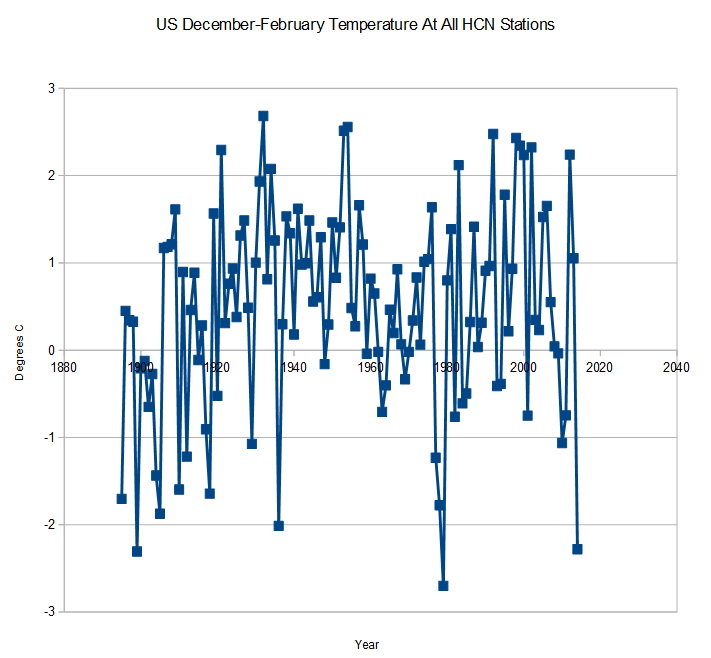
Third Coldest Winter On Record So Far In The US

Sharply Over The Last 80 Years →


Posted on February 16, 2014 by stevengoddard

If February ended today, this would be the third coldest winter on record in the US, after 1979 and 1899.

ScreenHunter_70 Feb. 16 12.51

Monday, February 17, 2014

Bloomberg's latest stats on school gun violence ignore reality (Fox News)


By John Lott

Published February 17, 2014

FoxNews.com

Are schools and colleges dangerous places, with lots of gun violence?

Some groups paint a picture of these places being particularly unsafe. Supposedly both murders and firearm suicides are very common at educational institutions. Last Wednesday, former New York Mayor Michael Bloomberg’s two groups, Moms Demand Gun Sense in America and Mayors Against Illegal Guns, jointly released a report that received massive uncritical news coverage.

They claimed that 44 shootings occurred in schools and colleges nationwide since the Newtown, Conn. massacre on Dec. 14, 2012 and Feb. 10 of this year. Out of the 44 shootings, a total of 28 died. To dramatize their numbers, Bloomberg’s groups emphasized that one of these attacks occurred every 10 days.

But their statistics are not what they seem. Included in the numbers are suicides. Also included are late night shootings taking place in school parking lots, on their grounds or even off school property, often involving gangs. As “shootings,” they also include any incident where shots were fired, even when nobody was injured.

Look at some of the cases included in their misleading statistics:

• A student at Eastern Florida State College retrieved his gun from his car when two men attacked him. One of the men was striking the student with a pool cue, and the student fired his gun wounding him. The gun was legally stored in the student’s car and the police found that he had acted in self-defense.

• A 19-year-old was killed at 9pm in a field near the Hillside Elementary School in San Leandro, California.

• A professor at the South Dakota School of Mines & Technology committed suicide in an empty classroom.

• A 23-year-old man committed suicide late at night on school grounds when no one was around the Algona High/Middle School in Iowa.

• A 38-year-old man was shot to death at 2am on the grounds of the Clarksville, Tennessee High School.

• A 19-year-old man committed suicide in the parking lot of a Portland, Maine high school. No one at the school was threatened.

The list goes on and on. Overall,

• About 40 percent of the deaths (11 out of 28) were suicides.

• Out of the 28 K-12 school shootings, at least four, possibly as many as eight, were gang shootings. Several of the college cases probably also involved gangs.

Indeed, gangs are a major problem. But they aren’t just a threat off school campuses. And some schools just happen to be located near dangerous areas, so the gang activity spills over to school grounds. Linking such violence to the Newtown tragedy is highly misleading.

Also, some perspective is needed. Contrary to what many people believe, high school shootings have actually been falling over the last two decades. To illustrate this let’s compare the five school years 1992-93 to 1996-97 with the five school years from 2008-09 to 2012-13. During the first period, the number of non-gang, non-suicide shooting deaths averaged 25 a year. During the recent five-year period, it averaged less than half that, 10 per year – and that figure does include the horrific Newtown massacre.

To put these numbers in perspective, there are about 50 million young people between the ages of 6 and 17. Another 21 million people are enrolled in colleges.

One of the motivations behind the report put out by the gun control groups was that the media was ignoring these so-called “mini-Newtowns.” Yet, all of these cases received extensive coverage. A gun at a school (or even near a school) is considered newsworthy. For example, USA Today ran at least one story on 24 of these cases.

Scaring Americans may be Bloomberg’s only tool for drumming up support for gun control laws. But it ultimately shows how little faith that gun control advocates have in their case.

Wednesday, February 12, 2014

Dependency, Not Poverty


Townhall.com ^ | February 12, 2014 | Walter E. Williams

Posted on ‎2014‎-‎02‎-‎12‎ ‎8‎:‎07‎:‎46‎ ‎AM by Kaslin

There is no material poverty in the U.S. Here are a few facts about people whom the Census Bureau labels as poor. Dr. Robert Rector and Rachel Sheffield, in their study "Understanding Poverty in the United States: Surprising Facts About America's Poor" (http://tinyurl.com/448flj8), report that 80 percent of poor households have air conditioning; nearly three-quarters have a car or truck, and 31 percent have two or more. Two-thirds have cable or satellite TV. Half have one or more computers. Forty-two percent own their homes. Poor Americans have more living space than the typical non-poor person in Sweden, France or the U.K. What we have in our nation are dependency and poverty of the spirit, with people making unwise choices and leading pathological lives aided and abetted by the welfare state.

The Census Bureau pegs the poverty rate among blacks at 35 percent and among whites at 13 percent. The illegitimacy rate among blacks is 72 percent, and among whites it's 30 percent. A statistic that one doesn't hear much about is that the poverty rate among black married families has been in the single digits for more than two decades, currently at 8 percent. For married white families, it's 5 percent. Now the politically incorrect questions: Whose fault is it to have children without the benefit of marriage and risk a life of dependency? Do people have free will, or are they governed by instincts?

There may be some pinhead sociologists who blame the weak black family structure on racial discrimination. But why was the black illegitimacy rate only 14 percent in 1940, and why, as Dr. Thomas Sowell reports, do we find that census data "going back a hundred years, when blacks were just one generation out of slavery ... showed that a slightly higher percentage of black adults had married than white adults. This fact remained true in every census from 1890 to 1940"? Is anyone willing to advance the argument that the reason the illegitimacy rate among blacks was lower and marriage rates higher in earlier periods was there was less racial discrimination and greater opportunity?

No one can blame a person if he starts out in life poor, because how one starts out is not his fault. If he stays poor, he is to blame because it is his fault. Avoiding long-term poverty is not rocket science. First, graduate from high school. Second, get married before you have children, and stay married. Third, work at any kind of job, even one that starts out paying the minimum wage. And finally, avoid engaging in criminal behavior. It turns out that a married couple, each earning the minimum wage, would earn an annual combined income of $30,000. The Census Bureau poverty line for a family of two is $15,500, and for a family of four, it's $23,000. By the way, no adult who starts out earning the minimum wage does so for very long.

Since President Lyndon Johnson declared war on poverty, the nation has spent about $18 trillion at the federal, state and local levels of government on programs justified by the "need" to deal with some aspect of poverty. In a column of mine in 1995, I pointed out that at that time, the nation had spent $5.4 trillion on the War on Poverty, and with that princely sum, "you could purchase every U.S. factory, all manufacturing equipment, and every office building. With what's left over, one could buy every airline, trucking company and our commercial maritime fleet. If you're still in the shopping mood, you could also buy every television, radio and power company, plus every retail and wholesale store in the entire nation" (http://tinyurl.com/kmhy6es). Today's total of $18 trillion spent on poverty means you could purchase everything produced in our country each year and then some.

There's very little guts in the political arena to address the basic causes of poverty. To do so risks being labeled as racist, sexist, uncaring and insensitive. That means today's dependency is likely to become permanent.

Sunday, February 9, 2014

What Happened The Last Time The Unemployment Rate Dropped This Much


Submitted by Tyler Durden on 02/08/2014 16:08 -0500

One of the biggest accomplishments of the president, in his own words, is managing to push the official (U-3) unemployment rate, from its post-Lehman high of 10% hit in October 2009 to only 6.6% as of January 2014 as Friday's jobs report revealed. This rapid drop in unemployment - call it the "Obama Recovery" - caught none other than the Fed completely unaware, whose 6.5% unemployment rate tightening threshold is now in tatters, as it the credibility of the Fed's forward guidance as the Fed will have no choice but to scrap all unemployment QE ending, rate hiking "thresholds" at its next FOMC meeting.

So what happened to the unemployment rate that it dropped so fast it surprised and embarrassed even the "venerable" Federal Reserve, which had initially expected a 6.5% unemployment rate some time in 2015. To get the answer we go back in time to the last (and only previous) time when the US unemployment rate dropped from roughly 10%, which was in June 1983, to 6.6%, which took place three and half years later, in December 1986 - let's call it the "Reagan Recovery" in short.

Here is how the old normal compares to the "New Normal."

  • US unemployment dropped from 10.1% to 6.6% between June 1983 and December 1986: an interval of 43 months.
  • US unemployment dropped from 10.0% to 6.6% between October 2009 and January 2014: an interval of 52 months.

So far so good: one can expect the "Obama Recovery" from the Great Financial Crisis to take a little bit longer than "Reagan's."

But what about the internals. This is where things start getting weird.

First, we look at the number of actual jobs added (according to the Establishment survey) from the 10% point at the peak to the 6.6% at the bottom. What we find is that despite the US workforce being over 30% larger today than it was 28 years ago, it took far less actual jobs created to drop the unemployment rate by 3.4%. Specifically, while the "Reagan Recovery" resulted in the creation of 10.5 million jobs, the "Obama Recovery" achieved the same low unemployment rate with only 7.5 million jobs added.

The difference between the Old and New Normal is even more acute when one looks at the change in average monthly job gains over the "recovery" period: as noted, in 1986 the duration of the rate drop period was 43 months, where currently it has taken 52 months. This means that the Obama recovery has resulted in just 145K job additions on average per month while the unemployment rate has dipped from 10.0% to 6.6%, compared to the far more impressive 244K - and indicative of a real recovery - that marked the 1983-1986 period.

However, nowhere is the distinction more acute when comparing the two "recoveries", then when one looks at the underlying population and labor force trends.

First, here is what a normal recovery looks like: during the Reagan Years, the Civilian, Non-institutional population - or the total number of Americans eligible for work whether they are part of the labor force or not - increased by 7.4 million, while the labor force increased by 6.7 million - as close to a linear relationship as possible, and also a correlation which any rational person would expect.

So how about the Obama recovery: well, we find that between October 2009 and January 2014, the civilian, non-institutional population rose by 10.4 million, to be expected considering the far greater general population of the US - it is also a number which, on average, increases by about 230K or so every month. So what about the labor force? It is here that things get zany (as we predicted they would many years ago), because it is here that the Obama Recovery has somehow only managed to add a paltry 1.7 million people to the workforce: from 153.8 million to 155.5 million!

Of course, the above unleashes the avalanche of "demographic" excuses which we have all grown to know and laugh at, because when economists can't explain something, they promptly fall back to patently false "justifications" - recall that as we explained the collapse in the labor force has very little to do with demographics, something which the BLS itself thought as recently as 2004 when it projected a rising labor force participation into the coming years only to readjust it lower in the coming years.

The real reason for this ongoing collapse in the labor force, is the same that the CBO used to explain why - in politically correct terms - Obamacare will adversely impact the labor force over the next decade: Americans will have to earn less to get full coverage, or said otherwise, they are less incentivized to work more. This is precisely the US welfare state at work, and when one extends the Obamacare "rationale" one sees that the administration's core goal is to make increasingly more people reliant on handouts than on labor, as we explained in "When Work Is Punished: The Tragedy Of America's Welfare State" in which we showed why "for increasingly more in America, it is more lucrative to sit, do nothing, and collect various welfare entitlements, than to work" as can be seen in the "welfare cliff" charts below (source).

Alas, that is the real reason why the labor force collapse continues and will continue even as America enters its next recession. Or depression.

So what happens when one renormalizes the unemployment rate calculation and uses a 30 year average labor force participation rate as a constant instead of a variable to be plugged by the BLS to goalseek a desired result? This happens:

What the chart above shows is that the "real" unemployment rate in October 2009 was 11.2%. Where is it now? 11.1%.

And there is your "Obama Recovery", when stripped of all the fancy veneer and TOTUSed propaganda, right there.

Average:

4.91781

Your rating: None Average: 4.9 (73 votes)

Saturday, February 8, 2014

Why We Lost The War On Poverty


http://townhall.com/columnists/johncgoodman/2014/02/08/why-we-lost-the-war-on-poverty-n1791483 ^ | February 8, 2014 | John C. Goodman

Posted on ‎2‎/‎8‎/‎2014‎ ‎10‎:‎36‎:‎44‎ ‎AM by Kaslin

Take a look at the graph below. From the end of World War II until 1964 the poverty rate in this country was cut in half. Further, 94% of the change in the poverty rate over this period can be explained by changes in per capita income alone. Economic growth is clearly the most effective antipoverty weapon ever devised by man.

The dotted line shows what would have happened had this trend continued. Economic growth would have reduced the number in poverty to a mere 1.4% of the population today ? a number so low that private charity could probably have taken care of any unmet needs.

But we didn't continue the trend. In 1965 we launched a War on Poverty. And as the graph shows, in the years that followed the portion of Americans living in poverty barely budged. In 1965, 18% of the population lived in poverty. Today we are at 15%, or 50 million Americans. That's after spending $15 trillion on antipoverty programs and continuing to spend $1 trillion a year.

 photo graph_zps0fa1646a.png

Now here is something you may not know. Early on ? in the first decade of our 50-year experiment with an expanded welfare state ? carefully controlled experiments funded by the federal government established without question that welfare changes behavior. It leads to the very behavioral changes that keep people in a state of poverty and dependency. Think about that. Any serious social science debate about the effects of welfare on the behavior of the recipients was resolved four decades ago!

We now know a lot about how behavior affects poverty. In fact, if you do these four things, it's almost impossible to remain poor:

1. Finish high school,

2. Get a job,

3. Get married, and

4. Don't have children until you get married.

So how does welfare affect behavior? In the late 1960s the federal government sought to find that out in what Charles Murray calls "the most ambitious social science experiment in history."

The experiments were all conducted by social scientists who believed in the welfare state and had no doubt about its capacity to be successful. In other words, they were confident of the answers before the experiments ever began. Their goal was to prove that popular wisdom was all wrong ? that welfare would not cause people to reduce their work effort, to get married less often, divorce more quickly or engage in other dysfunctional behavior.

The experiments were all controlled. Randomly selected people were assigned to a "control group" and an "experimental group." The latter received a guaranteed income, and the program even used Milton Friedman's term for it: a negative income tax. The largest, longest and best-evaluated of these experiments was SIME/DIME (Seattle Income Maintenance Experiment/Denver Income Maintenance Experiment) in Seattle and Denver. And the results were not pretty. To the dismay of the researchers, they largely confirmed what conventional wisdom had thought all along. As I reported in "Privatizing the Welfare State":

· The number of hours worked dropped 9% for husbands and 20% for wives, relative to the control group. For young male adults it dropped 43% more.

· The length of unemployment increased 27% among husbands and 42% for wives, relative to the control group. For single female heads of households it increased 60% more.

· Divorce increased 36% more among whites and 42% more among blacks. (In a New Jersey experiment, the divorce rate was 84% higher among Hispanics.)

BTW, these results have been studied and studied over and over again and there is a large literature on them ? almost all of it written by researchers who detested the outcomes. Good summaries are provided by Charles Murray and Martin Anderson.

Both authors point out that the results are even worse than they at first appear. For one thing, the "control group" had access to conventional welfare available in the 60s and 70s. So this was by no means a pure (welfare free) control group. Also the enrollees were given different instructions about how long they could expect their guaranteed income to last. It turns out that the longer the guarantee, the worse the negative effects.

So far as I can tell there was no marriage penalty in these experiments ? certainly nothing like we have today ? and little or no penalty for earning a higher income. With the passage of time all these incentives have become increasingly more perverse. For example, over the past 50 years we have added one marriage penalty after another to welfare benefits. There is a very strong marriage penalty in ObamaCare, for example. And even Paul Krugman concedes that the marginal tax rate faced by low-income families is in excess of 80% today. (It actually goes above 100% in many cases.) And ObamaCare will make the penalty for working and earning even higher.

So here is the important public policy question: If it is well established that self-sufficiency is closely related to working and being married why are we "fighting poverty" by doing things that social scientists have known for decades lead to less work and fewer marriages?

And here is a public discourse question: why are New York Times columnists Paul Krugman and Nicholas Kristof declaring the War on Poverty a success when it is so obviously a failure? Both columnists claim that if we count goods-in-kind (Food Stamps, housing, Medicaid, etc.), the actual poverty rate would be lower by one-third. Of course, if we give people enough stuff and count it as income, we could declare victory and claim that there is no more poverty.

Dylan Matthews makes much the same point that Krugman and Kristof make. After citing a Columbia University study on the different ways of measuring poverty, he zeroes in on the key point (how much difference does government make?) and says this:

…[T]he most noticeable trend here is that the gap between before-government and after-government poverty just keeps growing. In fact, without government programs, poverty would have actually increased over the period in question. Government action is literally the only reason we have less poverty in 2012 than we did in 1967.

Reviewing some of the early literature, I find it very difficult to determine what Lyndon Johnson would have called "success" in the war on poverty. But there is no doubt in my mind what the average citizen thinks success is. The goal is to have people earning enough and saving enough to support themselves above a poverty level income without any help from government.

So by that measure, there has been no progress at all ? despite spending $1 trillion a year on the effort.